Small Bedroom Ideas for Couples: 23 Ways to Share a Small Space
Two people, one small bedroom: the problem isn't fitting more furniture in, it's fitting the two of you around the bed — and around each other. Almost every "small bedroom" list is written for one person, so it skips the things that actually decide whether sharing works: whether you can both get out of bed without climbing over each other, whether the mattress leaves room to walk, whether the storage is fair, and whether you can sleep through the night when your schedules and thermostats disagree. Get those right and a small room shares comfortably. Here are 23 small bedroom ideas for couples — the right bed size for your room, the walkway numbers, two of everything, and how to sleep well together — all renter-friendly. This is the two-person companion to our small bedroom ideas guide, which covers the general storage, layout, and make-it-bigger basics.
Key Takeaways
- A small shared bedroom is a room-to-move problem, not a squeeze-in-more problem — plan for two people, not one.
- Match the bed to the room: a full leaves each of you about 27 inches (narrower than a crib), a queen 30 inches each, a king a whole twin each — a queen is the practical floor for two (Amerisleep).
- Leave 24–30 inches of walkway on both sides of the bed so neither of you climbs over the other (Homes & Gardens).
- Two of everything that matters — two nightstands (or wall-mounted), two reading lights, charging for two — plus a fair his-and-hers storage split.
- You can sleep well in one small bed: separate duvets fix temperature and cover-stealing without a second room, and wanting that is normal — nearly 1 in 3 US adults have resorted to a "sleep divorce" (AASM, 2025).
What makes these small bedroom ideas for couples work?
Four things, in this order: room to walk on both sides of the bed, not just one; a mattress sized to the room instead of the other way around; two of the essentials you each reach for (light, a surface, storage, a charger); and a plan for two different sleep styles. Nail those and a small room holds a couple and a calm night's sleep. Skip them and even a generous room feels cramped and one-sided. Everything after that — palette, art, plants — is decoration. So we start with the bed and the floor around it.
Get the bed and the walkways right for two (1–5)
The single biggest decision in a shared small bedroom is the bed, because it sets everything else: the walkways, the storage, whether both of you can actually use the room.
1. Match the mattress to the room, not your dreams
Everyone wants the biggest bed that "fits." The honest math is about what's left for each of you. A full (54 inches wide) splits to about 27 inches per person — narrower than a crib. A queen (60 inches) gives you 30 inches each. A king (76 inches) gives you 38 inches each — a whole twin bed apiece (Amerisleep). That's why couples who "upgrade" from a full to a queen feel like they gained a bedroom: it's three extra inches of personal space each, every night. Here's how each size maps to the room it realistically needs:
| Mattress | Width | Each of you gets | Room you realistically need |
|---|---|---|---|
| Full / Double | 54 in | ~27 in (narrower than a crib) | ~9.5' × 10.5' |
| Queen | 60 in | 30 in | ~10' × 10' |
| King | 76 in | 38 in (a whole twin) | ~12' × 12' |
Source: Amerisleep mattress size chart (2026). The takeaway: a queen is the practical floor for two adults, and a king needs roughly a 12×12 room or it swallows the walkways you're about to read about. In most small bedrooms, a queen is the sweet spot — big enough to share, small enough to walk around.
2. Leave 24–30 inches of walkway on both sides
This is the number no one gives couples. To get in and out without climbing over your partner, you want 24 to 30 inches of clear floor on each side of a queen — and 30 to 36 inches for a king (Homes & Gardens). Leave another 30 to 36 inches at the foot so you can pass and make the bed. Two-sided access is the whole difference between a bed two people share and a bed one person is trapped against the wall in.
3. Center the bed on the longest wall
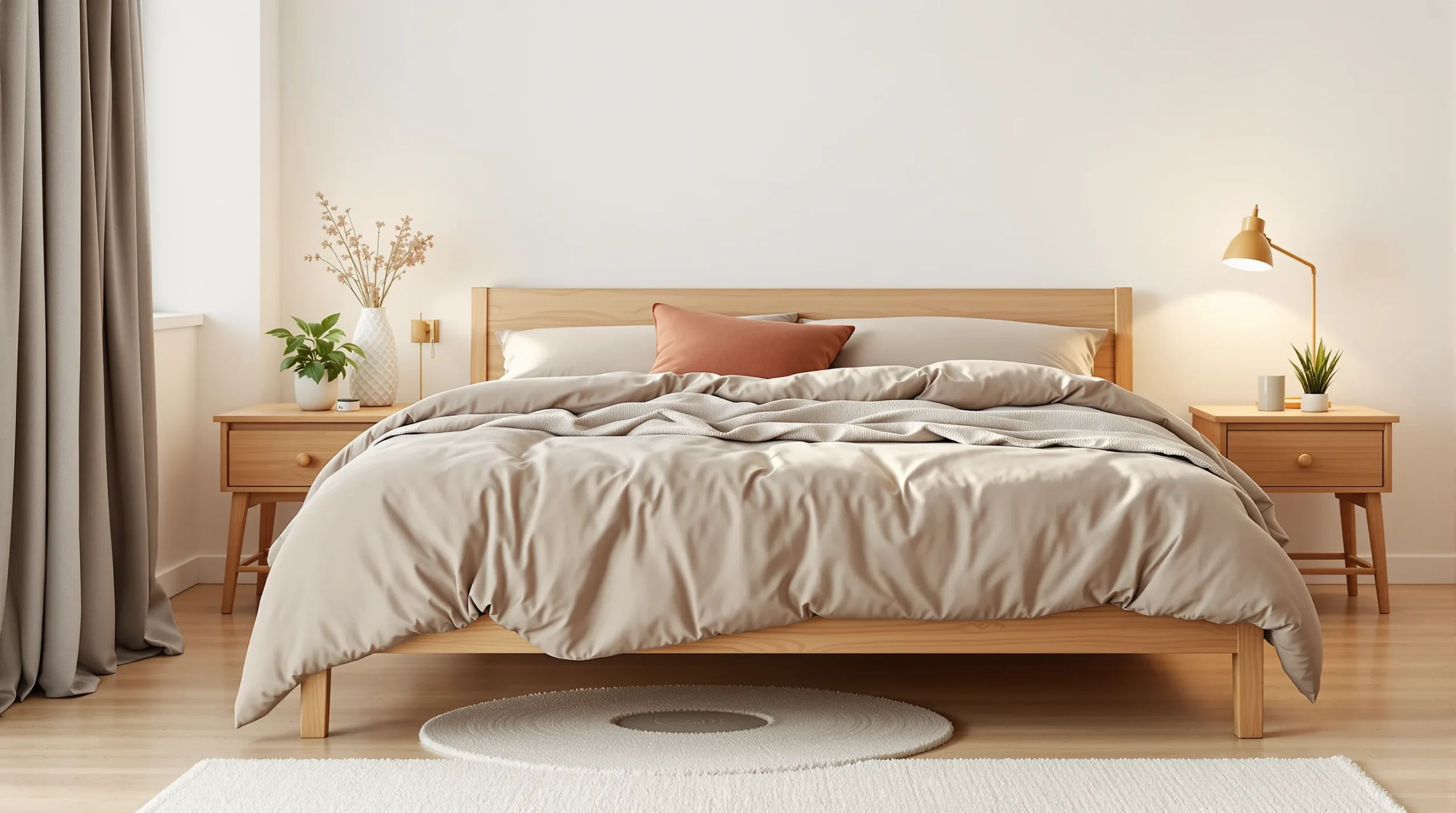
Two-sided access only happens if the bed is centered, not shoved into a corner. Put the headboard in the middle of the longest uninterrupted wall so there's floor on both sides. A corner-pushed bed saves a few inches and costs you a partner who has to crawl over you every morning — the most common small-shared-bedroom mistake there is.
4. Mind the door and the closet swing
A room can measure "big enough" on paper and still feel tight because of the doors. Keep the bed off the door's path (aim for the bed to sit at least a yard clear of a swinging door), and don't park it where it blocks the closet or bathroom door from opening fully. Map the swing arcs before you place furniture — it's the hidden reason a couple's room feels smaller than its square footage.
5. If the room can't give both sides, choose the trade on purpose
Some rooms genuinely can't offer two full walkways. Fine — just decide together instead of defaulting. Either push one long side to the wall and add a bench at the foot so the inside sleeper exits over the end, or drop down a mattress size to reclaim a walkway. A deliberate trade you both agreed to beats an accidental squeeze one of you quietly resents. (For the general small-room layout playbook, our small bedroom ideas hub has the rest.)
Two of everything — his and hers (6–10)
The fastest way to make a shared room feel fair is to stop making two people share one of everything. Doubling the small essentials matters more than any single big purchase.
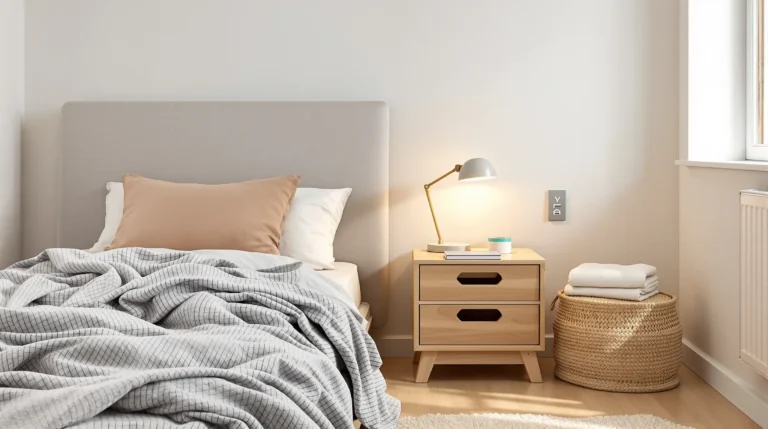
6. Two nightstands, even tiny ones
A surface each — for a phone, a glass of water, glasses, a book — ends the nightly reach-over and the silent argument about whose stuff gets the one table. If two full nightstands won't fit, they don't have to match or be big; a narrow ledge, a stool, or a wall shelf on the tight side counts. What matters is that each of you has one.
7. Wall-mount the nightstands to reclaim the floor
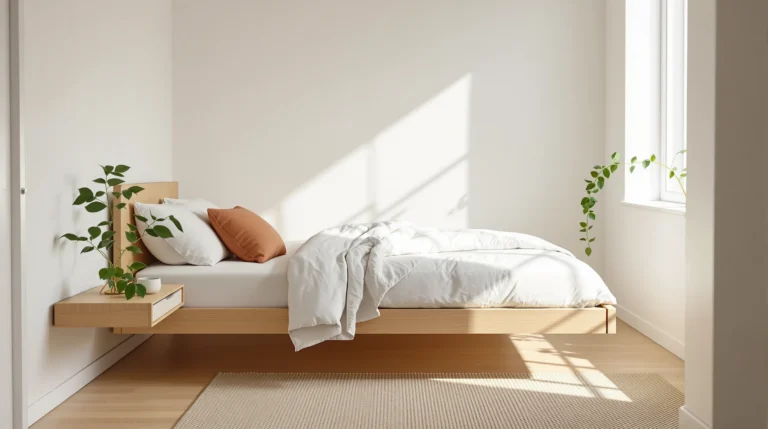
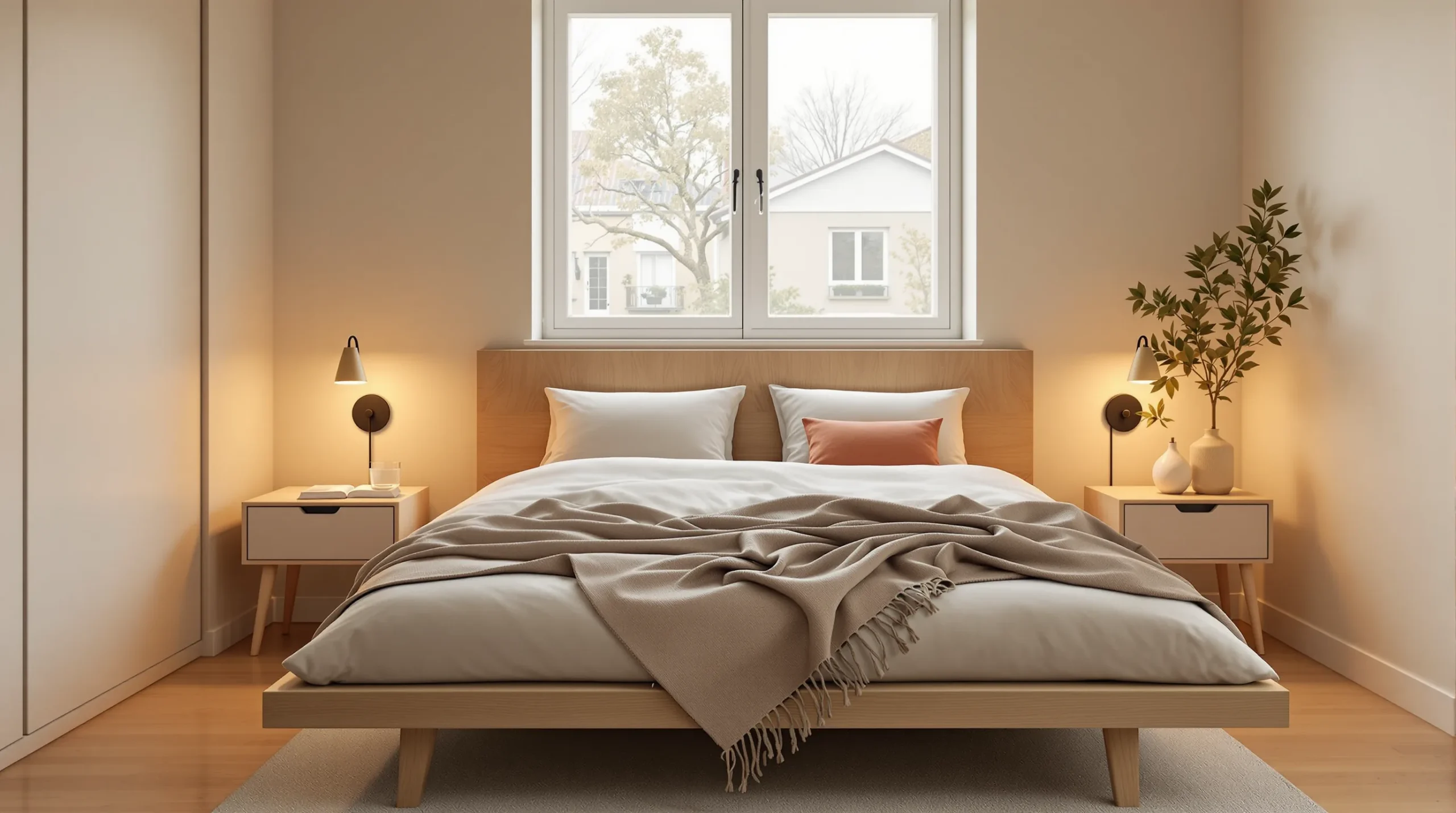
When the floor is too tight for two nightstands, put them on the wall. A floating shelf or ledge on each side clears the walkway completely, and designers generally recommend setting the surface within a couple of inches of the mattress top so it's easy to reach lying down. No-drill version: a Command-mounted ledge or a hook-on bedside caddy that clips to the frame — a surface each with nothing screwed into a rental wall.
8. Two reading lights so one can sleep while one reads
If your schedules differ even a little, individual lighting is a peace treaty. Give each side its own light — a plug-in or stick-on wall sconce, or a clip light on the headboard — aimed down at the reader, not across the bed at the sleeper. Stick-on sconces are the renter swap for hardwired ones: no electrician, no holes. For the warm bulb color that keeps a bedroom restful, see our cozy bedroom guide.
9. Sort out charging for two
One free outlet and two phones is a nightly standoff. Put a slim power strip behind a nightstand or use a two-port bedside lamp or charger so each of you has a plug within reach. It's a five-dollar fix that removes a daily micro-friction most couples never think to name.
10. Give each person a zone that's theirs
When my partner and I first shared a small bedroom, the room only calmed down once we stopped pooling everything. We gave each person one drawer, one shelf, and one hook that was theirs — no negotiation, no creep. It sounds almost too simple, but a "your side" split is what lets a shared tiny room still feel personal instead of like one person's stuff slowly annexing the other's. Decide the zones on day one; it's far harder to un-tangle later.
Storage for two without a second dresser (11–15)
Two people own roughly twice the stuff and have the same floor. The answer isn't a second dresser you can't fit — it's storage the room is already hiding.
11. Use the space under the bed — his bins and hers
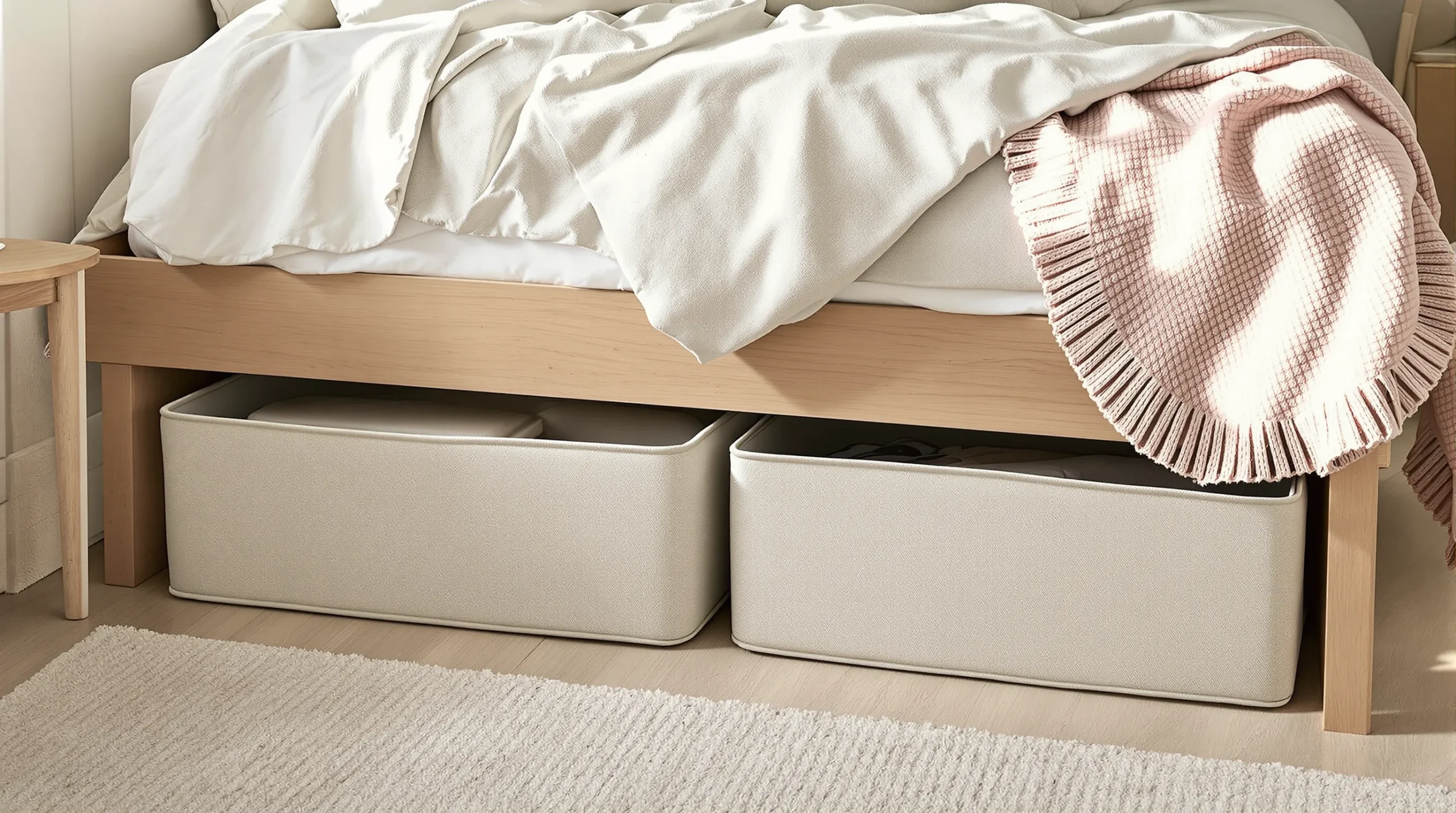
The footprint under the bed is the biggest storage you already own. Aim to keep at least 6 inches of clearance so bins slide in and out and you can still clean under there (Apartment Therapy); add bed risers if your frame sits lower. Then split it fairly — his bins on his side, hers on hers — so under-bed storage doesn't become a contested junk drawer.
12. Let the bed be the storage
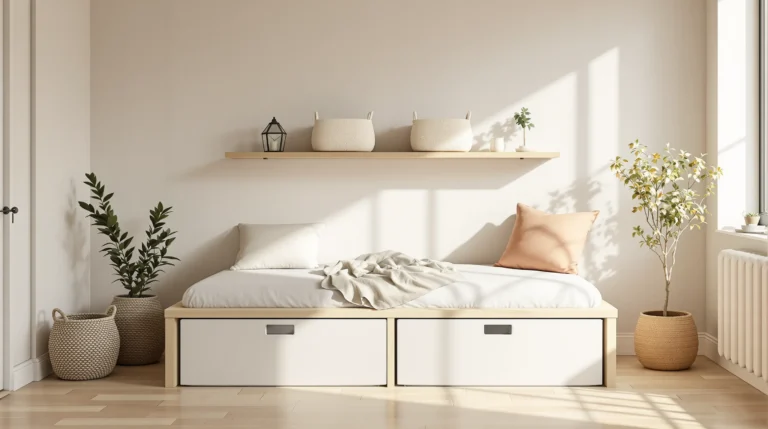
A storage bed with drawers in the base, or a lift-up ottoman bed, roughly doubles a small room's storage without adding a single piece of furniture to the floor. For a couple, that's the highest-leverage buy in the room — it turns dead space under the mattress into a real his-and-hers dresser. We break down these dual-purpose pieces in our space-saving furniture guide.
13. Add an ottoman bench at the foot
A storage bench at the foot of the bed does three jobs at once: a place to sit and put on shoes, hidden storage for spare bedding or off-season clothes, and — crucially for a couple — a landing spot for clothes so they don't pile on "her" chair or "his" side of the floor.
14. Go vertical and over-the-door
Two people's storage has to grow up, not out. Tall, slim shelving and over-the-door organizers add a second person's worth of storage without taking a second person's floor. (For the general vertical-storage playbook — shelves, wall hooks, the works — see the small bedroom ideas hub; here the point is simply that going up is how two people fit.)
15. Add a slim rolling rail as a second wardrobe
One closet rarely splits evenly between two wardrobes. A narrow rolling garment rack gives the second person real hanging space, tucks into a corner or beside the closet, and needs zero drilling — the renter-friendly fix when "we'll share the closet" turns out to mean one of you living out of a suitcase.
Sleep well together in a small bed (16–19)
Sharing a small bed is where couples quietly struggle — covers, temperature, schedules, snoring. The good news: most of it is a design problem, not a relationship one, and you can solve it without a second room.
16. Try separate duvets — the Scandinavian method
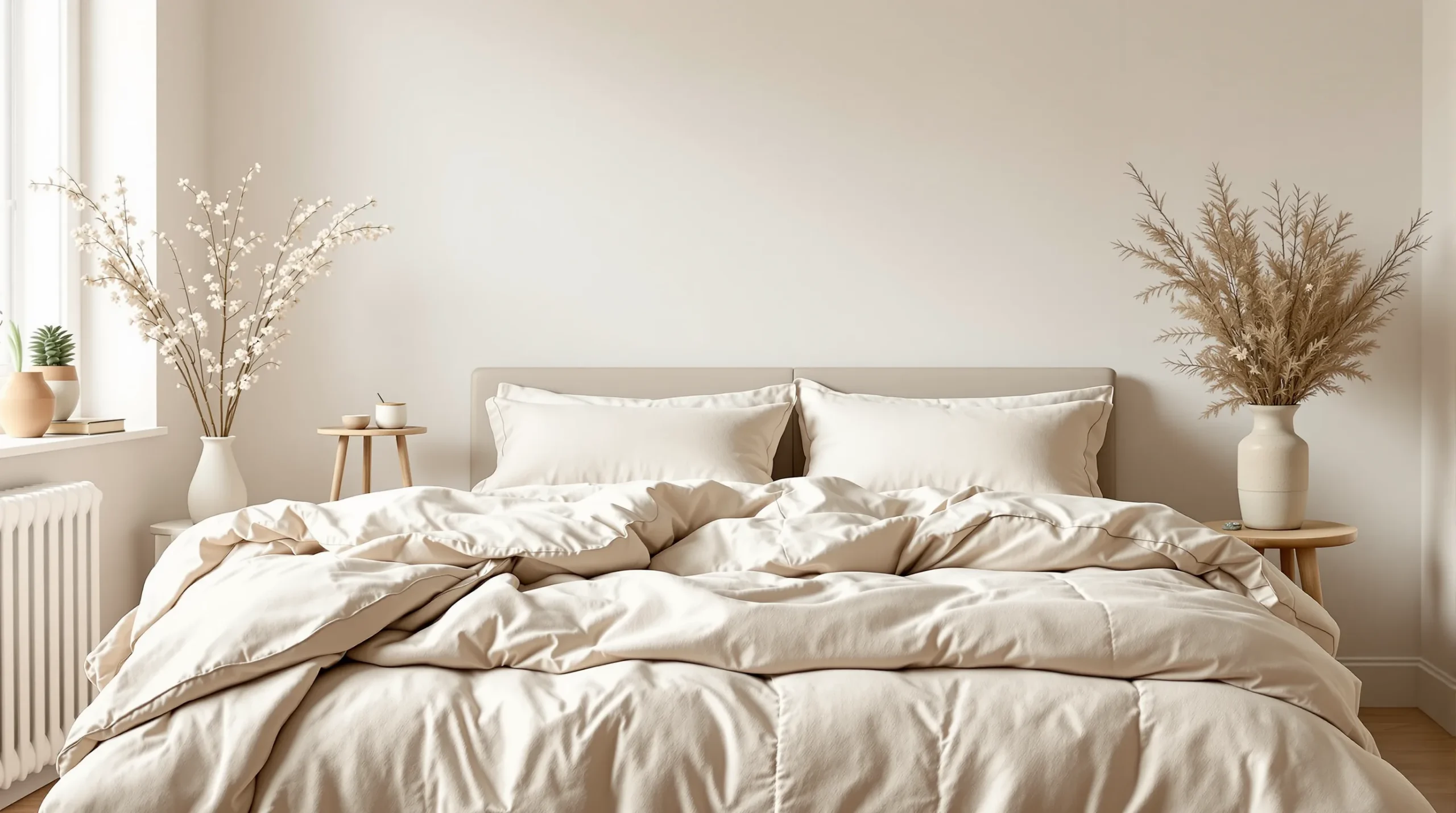
The single best upgrade for two people in one bed is two duvets. The Scandinavian sleep method — two twin-size duvets on one shared mattress instead of one big one — ends cover-stealing and lets each person choose their own warmth, while you still share the bed (Sleep Foundation). Make the bed by folding both duvets in thirds side by side; it looks intentional, almost hotel-like. It's the rare fix that solves two of the biggest shared-bed fights at once and costs nothing but a second duvet.
17. Design around different schedules
When one of you is up later, build the room so the night owl doesn't wake the early bird. A silent, vibrating alarm; the individual reading light from idea 8; and a little white or brown noise to blur the sound of someone moving around all help. If one partner works or scrolls late, a curtain or a small zoned corner keeps that activity out of the sleeper's sightline — the same one-room-zoning trick that makes a studio apartment layout work, shrunk to a bedroom.
18. Solve the temperature war
Different bodies want different temperatures, and thermostat fights are really bedding problems. Separate duvets (idea 16) let each person pick a lighter or heavier fill. Add a cool-side/warm-side split — a breathable cotton layer for the hot sleeper, a heavier throw for the cold one — and a small clip fan on the warm sleeper's side. Compromise by zone, not by fighting over one dial.
19. Know you're not failing — and that design fixes most of it
If sharing a small bed is hard, you're in normal company. Nearly 1 in 3 US adults (about 31%) have had a "sleep divorce" — sleeping in another bed or room to accommodate a partner — and 37% regularly go to sleep at a different time than they'd like for their partner's sake (AASM, 2025). Roughly 1 in 6 couples sleep in separate rooms at least one night a week (ATS, 2026). The point isn't that you should sleep apart — it's that the frictions behind those numbers (snoring, schedules, temperature, cover-stealing) are common and mostly solvable in one small bed with two duvets, two lights, and a little white noise.
You don't need a second bedroom to sleep well together — you need two duvets, two lights, and a plan for two schedules.
Make a shared small room feel bigger and calmer (20–23)
Once the room works for two, a few restrained moves make it feel bigger — and keep two people's belongings from reading as clutter.
20. Pick one palette you both live in
The fastest way for a shared room to feel calm is a single agreed palette. When both of your belongings sit on the same warm-neutral base — oat, greige, a shared accent — the room reads as one intentional space instead of his-stuff-versus-her-stuff. Agree on three or four tones and let everything visible lean into them. The same warm-neutral thread runs through our small living room ideas if you want the whole place to flow.
21. Go low-profile and leggy
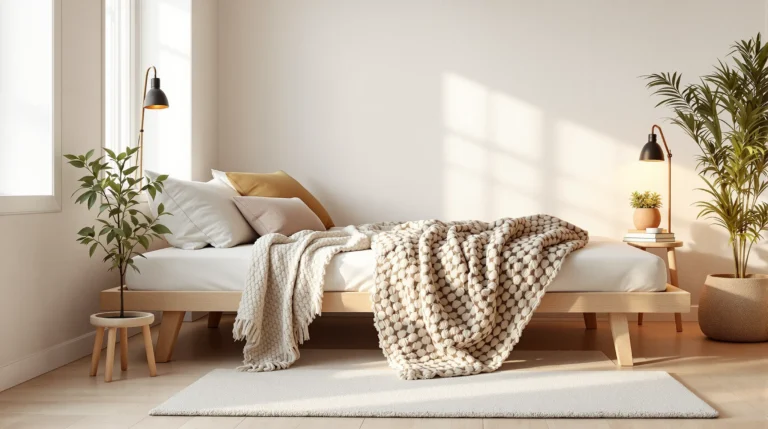
A low bed and furniture with visible legs keep sightlines open, so a full room breathes instead of feeling packed. That matters more with two of you: when both people's belongings compete for the same floor, every inch of visible floor and wall makes the shared room feel bigger — one of the core make-it-bigger moves covered in depth in the small bedroom ideas hub.
22. Keep one shared landing tray by the door
Two people generate twice the pocket clutter — keys, watches, earrings, chargers. One shared tray or wall pocket by the door catches all of it in a single spot, so the surfaces stay clear and the room stays calm. It's a tiny habit that does more for a shared room's sense of space than most furniture.
23. Keep the warmth without the clutter
A shared room should still feel cozy — just not crowded. One enclosing gesture and some soft texture warm a small room for two without piling on stuff; the actual how of cozy (the bulb color, the bed-layering formula, a no-drill nook) lives in our cozy bedroom ideas guide. Warmth and restraint aren't opposites — in a small shared room they're the same move.
Couple's small-bedroom mistakes to avoid
Most shared-bedroom regrets trace back to five avoidable choices:
- Cramming a king into a 10×10 — it kills both walkways; size the bed to the room, and in most small rooms that means a queen.
- Nightstands and lights on one side only — the room instantly belongs to one person; double the small stuff.
- Ignoring the door and closet swing — a "big enough" room feels tight when the bed blocks a door arc.
- Sticking with one duvet when you fight over covers or temperature — two duvets solve both for the price of one.
- Letting one person's things colonize both sides — set a fair his-and-hers split on day one instead of untangling it later.
Frequently asked questions
What size bed fits a small bedroom for a couple?
A queen is the practical floor for two adults — it gives each of you 30 inches of personal width and fits a room around 10×10. A full only leaves about 27 inches each (narrower than a crib), and a king needs roughly a 12×12 room or it eats your walkways. In most small bedrooms, a queen shares best (Amerisleep).
How much space do you need around a bed for two people?
Leave 24 to 30 inches of clear floor on each side of a queen so neither of you climbs over the other, 30 to 36 inches for a king, and 30 to 36 inches at the foot to pass and make the bed (Homes & Gardens). Two-sided access is what separates a bed a couple shares from a bed one person is pinned against the wall in.
How do couples share a small closet?
Split it fairly first — divide the rod and shelves in half rather than letting one wardrobe take over — then add capacity for the second person with a slim rolling garment rack, over-the-door organizers, and under-bed bins. The goal is that each of you has real, defined space, not that you both cram into one half.
How do couples sleep in a small bed without waking each other?
Use two separate duvets (the Scandinavian method) to stop cover-stealing and temperature fights, give each side its own reading light, add white or brown noise for the lighter sleeper, and use a silent vibrating alarm for whoever wakes first. Most shared-bed friction is solvable in one bed.
Is it normal for couples to want separate duvets or even separate beds?
Completely — about 31% of US adults have had a "sleep divorce" at some point, and roughly 1 in 6 couples sleep in separate rooms at least one night a week (AASM, 2025; ATS, 2026). Separate duvets are the middle path: you keep sharing the bed while each choosing your own warmth and covers.
How do you make a shared small bedroom feel bigger?
Right-size the bed to the room, keep two-sided walkways clear, choose one shared palette so two people's things read as one calm space, and use low-profile, leggy furniture to open up sightlines. For the full make-it-bigger playbook — mirrors, rug sizing, and layout — see our small bedroom ideas hub.
Room to move, room to sleep
A small bedroom can absolutely hold a couple — you just have to design it for two instead of one. Size the bed to the room (a queen, usually), leave 24 to 30 inches of walkway on both sides, double the small essentials, split the storage fairly, and put two duvets on the bed so you sleep well together. Do that and a tight room feels like a shared home, not a nightly negotiation. For the storage, layout, and make-it-bigger basics underneath all of this, head to our full small bedroom ideas guide.
Pick two or three ideas and try them this week — start with the bed size and the walkways. Then grab the free small-space checklist for the couple's small-bedroom shopping list, and save the ideas from our Small Bedroom Inspiration board. Setting up the rest of your place together? See space-saving furniture and small living room ideas.
Written by Nourddine, founder of Calm Square Feet, where he shares warm-minimalist, renter-friendly ideas for small apartments and studios. [More about me → /about].
Sources
- Amerisleep, Mattress Sizes and Dimensions Chart, retrieved 2026-07-08, https://amerisleep.com/blog/mattress-sizes-and-dimensions-chart/
- Homes & Gardens, An expert guide to bedroom clearances, measurements and spacing, retrieved 2026-07-08, https://www.homesandgardens.com/interior-design/bedrooms/an-expert-guide-to-bedroom-clearances-measurements-and-spacing
- American Academy of Sleep Medicine (AASM), Sleep divorce survey, 2025, retrieved 2026-07-08, https://aasm.org/new-survey-data-sleep-divorce/
- Sleep Foundation, The Scandinavian Sleep Method, retrieved 2026-07-08, https://www.sleepfoundation.org/sleep-hygiene/scandinavian-sleep-method
- Medscape / American Thoracic Society, About 1 in 6 Couples Report Sleeping in Separate Rooms at Least One Night a Week, 2026, retrieved 2026-07-08, https://www.medscape.com/viewarticle/about-1-6-couples-report-sleeping-separate-rooms-least-one-2026a1000j6w
- Apartment Therapy, This Is the Ideal Height for Your Bed (for Cleaning and Storage), retrieved 2026-07-08, https://www.apartmenttherapy.com/bed-height-cleaning-37041080