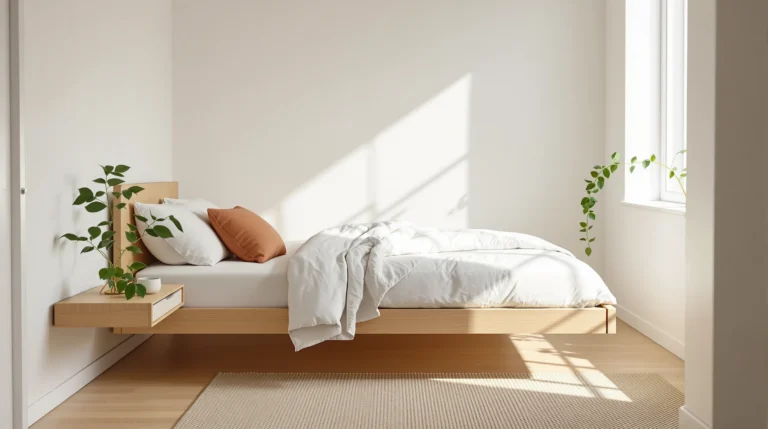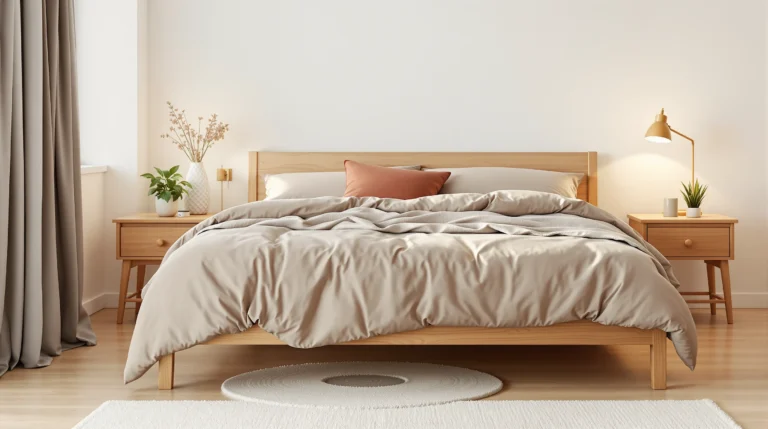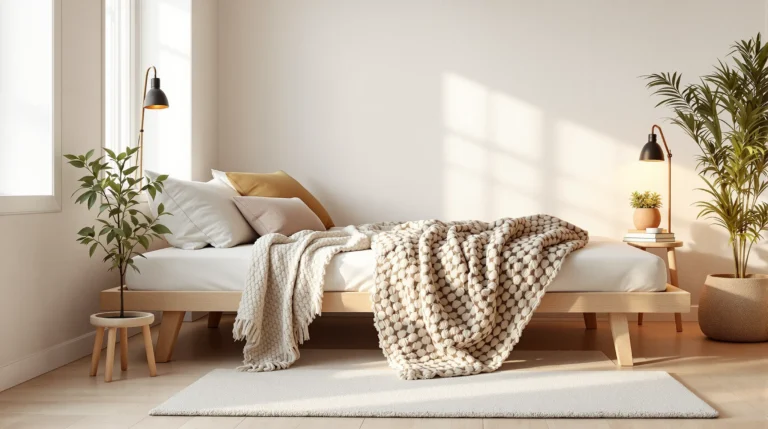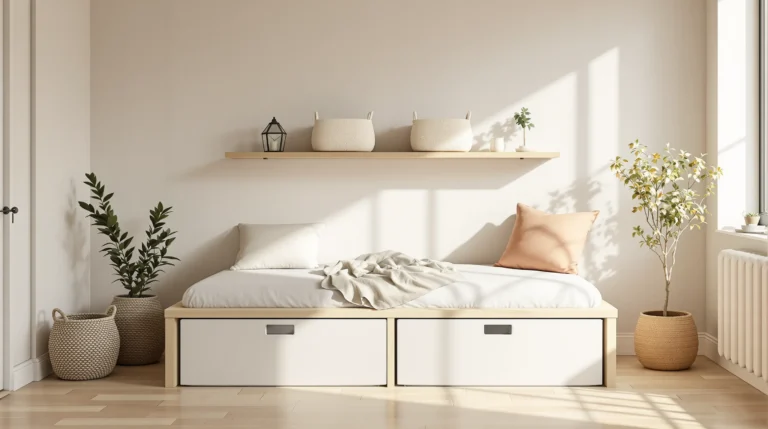
Bedroom Ideas for Small Rooms DIY: 23 Renter-Safe Projects
DIY roundups love to show you 74 headboards and zero numbers. Then Saturday comes: the adhesive hook drops your canopy at 2 a.m., the peel-and-stick takes paint off with it, and the deposit you were protecting is suddenly in play. This guide is built differently. Here are 23 bedroom ideas for small rooms DIY — and every single one carries a spec card: what it costs, how long it takes, how hard it is, and the renter-safe way to do it. The urge is real, and you're not alone in it: one 2025 survey of 2,000 US renters found 38% said they'd be likely to modify their place even without express permission (Talker Research). You don't have to gamble — every project here comes back off the wall. This is the hands-on companion to our small bedroom ideas guide, which covers the storage, layout, and make-it-bigger theory.
Key Takeaways
- Every project below has a spec card — cost range, time, difficulty — and a renter-safe route with no drilling.
- Know your weight limits first: Command picture strips hold 1–4 lb per set (a large frame spreads across four sets) and curtain-rod hooks about 10 lb, but ceiling hooks hold only half a pound (manufacturer-listed — recheck the pack you buy).
- Prep prevents the classic failures: wipe the wall with rubbing alcohol, press 30 seconds, wait an hour before loading (3M); peel-and-stick wallpaper wants satin or semi-gloss paint that's cured 30–60 days (Tempaper; WallPops).
- Pick three projects and one palette, so a weekend of DIY reads as one calm room — not a craft fair.
What makes these bedroom ideas for small rooms DIY work?
Three things, before any project starts. First, know the real weight limits of whatever adhesive or tension hardware you're using — most "it fell off the wall" stories are just arithmetic. Second, prep the way the manufacturers say, because the instructions everyone skips are where the deposit gets saved. Third, choose builds that lean, tension, or stand free instead of drilling, and keep them in one palette. Do that and DIY makes a small bedroom feel genuinely yours; skip it and you're re-spackling in August.
Before you stick anything — the ground rules (1–3)
Ten minutes of reading saves every project that follows. These three rules are the difference between "renter-safe" as a promise and as a fact. (One housekeeping note: every cost below is a 2026 estimate — prices vary, so check before you shop.)
1. Learn the real weight limits
Adhesive hardware has exact ratings, and almost nobody checks them. On 3M's own weight-limit directory, Command picture-hanging strips carry 1 lb (small), 3 lb (medium), and 4 lb (large) per set — and since a frame typically hangs on four sets, a large-strip frame can spread roughly 16 lb across them (3M/Command; ratings are manufacturer-listed and per product, so recheck the pack you buy). Their hooks top out lower than people assume — a Large hook holds 5 lb and the Jumbo 7.5 lb — while wall-mounted curtain-rod hooks are listed at about 10 lb. The trap: Command ceiling hooks are rated at half a pound — they're for paper lanterns, not canopies. Tension rods spread just as wide: a quality rod like Umbra's Anywhere is rated to 15 lb (Umbra), while the cheapest big-box rods carry as little as 3–4 lb (Lowe's listing). Weigh what you're hanging, read the rating, and the number-one DIY failure disappears. Here's the whole cheat sheet in one place:
| No-drill hardware | Listed rating |
|---|---|
| Command ceiling hook | 0.5 lb |
| Command poster strips | 1 lb |
| Command picture strips, small | 1 lb per set |
| Command picture strips, medium | 3 lb per set |
| Command picture strips, large | 4 lb per set (a frame on 4 sets ≈ 16 lb) |
| Command Large hook | 5 lb |
| Command Jumbo hook | 7.5 lb |
| Command curtain-rod hooks (wall) | ~10 lb |
| Quality tension rod (e.g., Umbra Anywhere) | 15 lb |
Ratings are manufacturer-listed and per product/per set — always recheck the pack you buy.
2. Prep the wall like 3M says
I learned this one the expensive way: my first no-nail frame was face-down on the floor by morning, and the strip hadn't failed — my prep had. The manufacturer's own protocol, which I now follow like scripture: wipe the spot with rubbing alcohol (not household cleaner, which leaves residue), press the strip for a full 30 seconds, then wait an hour before hanging anything on it (3M's application FAQ). And know where adhesive simply doesn't work: textured walls, brick, fabric, and wallpaper are all no-go surfaces. Removal is the reverse ritual — stretch the tab slowly straight down and it releases clean.
3. Test before you commit
Peel-and-stick wallpaper is renter-famous for good reason, but it has conditions the roundups skip. It wants a smooth wall painted in satin or semi-gloss — not flat or matte, where removal can pull paint (Tempaper). Fresh paint needs to cure 30 to 60 days before anything sticks to it, and the maker's own advice is to order a sample and test a corner first (WallPops FAQ). Ten dollars of sample now beats a strip of missing paint at move-out.
DIY the bed wall (4–8)
The wall behind the bed is a small room's stage — and every project on it can be done without a single hole.
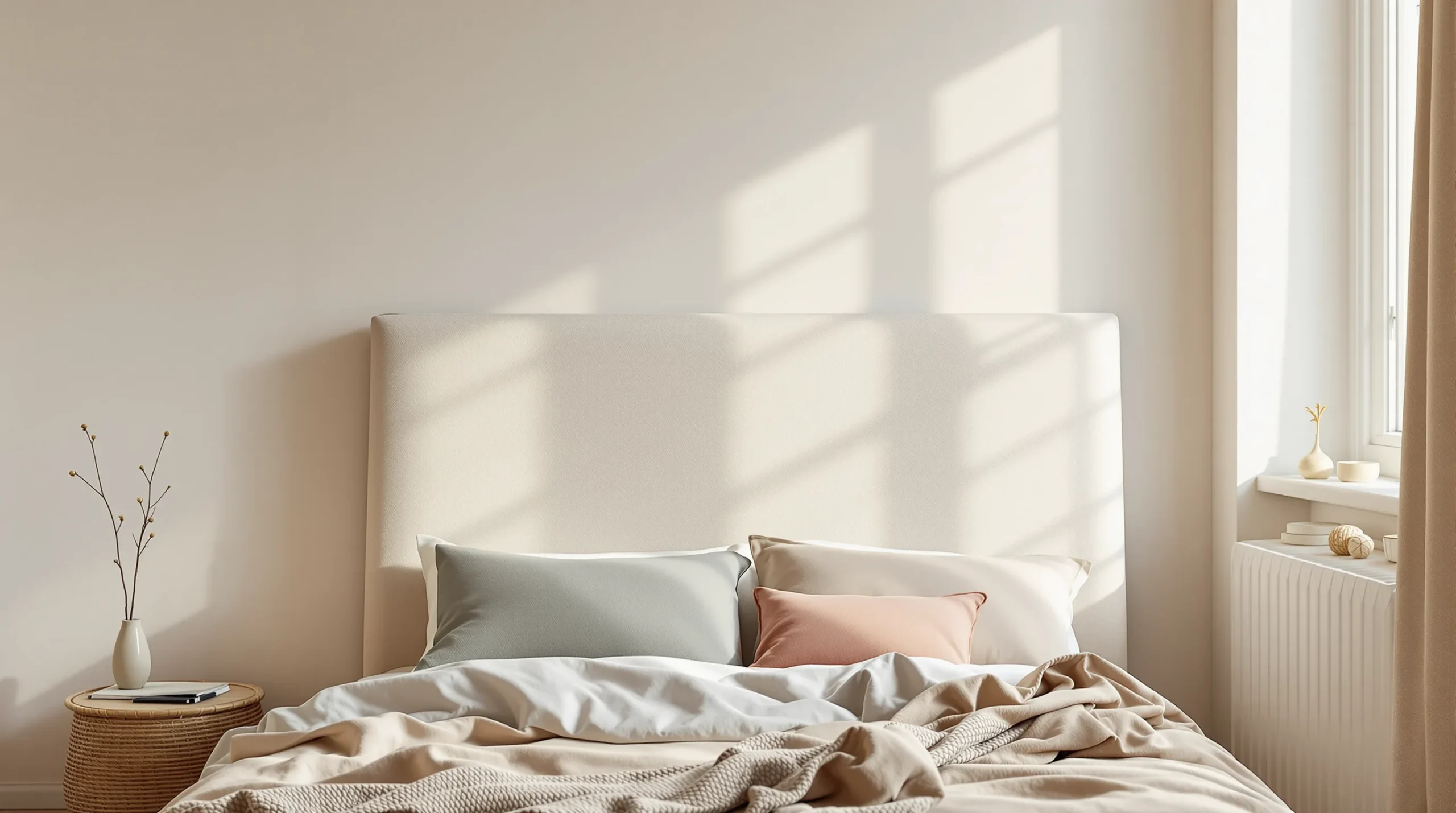
4. Build an upholstered leaning headboard
Cost: ~$40–100 · Time: 2–3 hours · Difficulty: Medium · Renter-safe: it leans — zero holes.
Cut (or have the hardware store cut) a plywood panel to your bed's width, glue on foam, wrap batting and fabric around the back, and staple. Lean it behind the mattress and the bed itself pins it in place. This was my first real build, with a borrowed staple gun on a Sunday afternoon, and it's still the highest-payoff project I've done — the room looked custom by dinner. Go nubby with the fabric (bouclé, linen) in a warm neutral. If you make it much taller than the mattress line, treat it like any tall furniture and secure it — the one-line anchoring rule from our kids' room guide applies to grown-up rooms too.
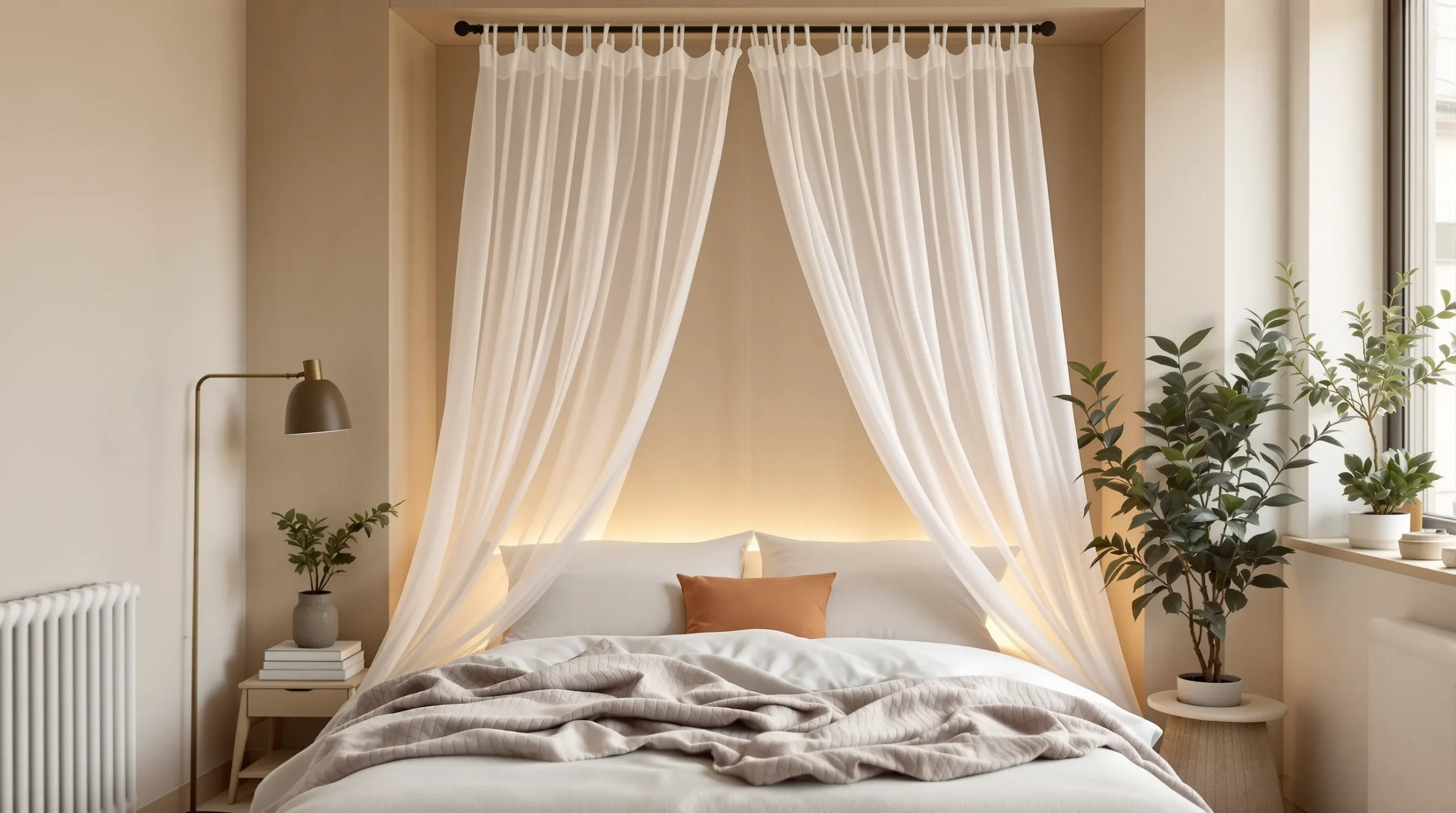
5. Hang a sheer half-canopy the safe way
Cost: ~$25–60 · Time: ~1 hour · Difficulty: Easy · Renter-safe: wall hooks or a tension rod — never ceiling hooks.
A half-canopy of sheer voile turns a small bed into a cocoon — the why-it-works lives in our cozy bedroom guide. The build that doesn't end at 2 a.m.: hang a light rod on wall-mounted adhesive curtain-rod hooks (rated ~10 lb), or span a tension rod (15 lb-rated) across an alcove — and skip adhesive ceiling hooks entirely, because at half a pound they can't hold fabric that moves. Keep the sheers featherweight and any lights nearby LED-only.
6. Frame the bed in string lights
Cost: ~$15–40 · Time: ~1 hour · Difficulty: Easy · Renter-safe: adhesive decorating clips.
A warm LED string traced around the bed wall — up one side, across, down the other — reads like a built-in glow. Use Command decorating clips (made exactly for this), never pinch cords under the clip, and choose warm-white LEDs. It's the cheapest "designed" moment in this list.
7. Peel-and-stick an accent wall
Cost: ~$60–150 (2–4 rolls) · Time: 2–4 hours with a helper · Difficulty: Medium · Renter-safe: if — and only if — idea 3's conditions hold.
One patterned wall behind the bed changes the whole room, and in a small bedroom one wall is all you want. Recruit a second pair of hands, start from a plumb line at the ceiling, smooth outward as you go, and save the offcuts for repairs. On flat paint or a fresh repaint, choose the washi grid (next) instead — the manufacturers themselves say the risk is yours on the wrong surface.
8. Washi-tape a headboard outline or wall grid
Cost: ~$10–25 · Time: 1–2 hours · Difficulty: Easy · Renter-safe: the lowest-risk wall treatment there is.
Draw a headboard where there isn't one — a simple arch or rectangle of warm-toned washi tape — or grid an entire wall into calm squares. It's graphic, oddly grown-up in one color, and peels off clean. (Even here: test a strip on flat paint first.)
No-nail walls — art and mirrors (9–12)
Art is where deposits usually die. All four of these hang or lean with zero nails.
9. Hang a gallery wall with zero nails
Cost: ~$20–80 with thrifted frames · Time: 1–2 hours · Difficulty: Easy · Renter-safe: strips sized to each frame.
What makes it work is one habit: weigh each frame and match it to the strip size — one set per corner, so four large sets carry a frame of up to roughly 16 lb — and give every strip its alcohol-wipe and one-hour rest (ideas 1–2). Lay the arrangement on the floor first, then transfer. Thrifted frames spray-painted one color turn chaos into a set.
10. Lean one oversized piece
Cost: ~$30–80 · Time: 10 minutes · Difficulty: Easy · Renter-safe: it touches nothing.
The anti-gallery: a single big frame or canvas leaned on the dresser or floor against the bed wall. One oversized piece calms a small room where ten small ones clutter it — and "hanging" it takes ten minutes, most of which is stepping back to look.
11. Frame a plain mirror with adhesive trim
Cost: ~$20–50 · Time: 1–2 hours · Difficulty: Easy · Renter-safe: stick-on molding, leaning mirror.
A bare builder mirror or a $20 full-length turns designer with peel-and-stick molding around its edge — paint the trim before you stick it. If the mirror leans, strap it (the same anti-tip rule from the kids' guide). For where mirrors do the most for a small room, the small bedroom ideas hub covers the placement theory.
12. The picture-ledge honest call
Cost: ~$15–40 · Time: 30–60 minutes · Difficulty: Easy · Renter-safe: only with the swaps below.
Here's what the roundups won't say: a proper picture ledge like IKEA's MOSSLANDA holds a generous ~16.5 lb but installs with screws (IKEA) — it's an owner project. Renter swaps: stand the ledge on the dresser as a leaning display rail, or run large strips with genuinely light frames instead. Honesty now beats spackle later.
Nightstands you barely have to build (13–16)
A small bedroom rarely has room for a real nightstand — these four make one from almost nothing. (If you'd rather buy multifunction than build, our space-saving furniture guide covers the pieces worth it.)
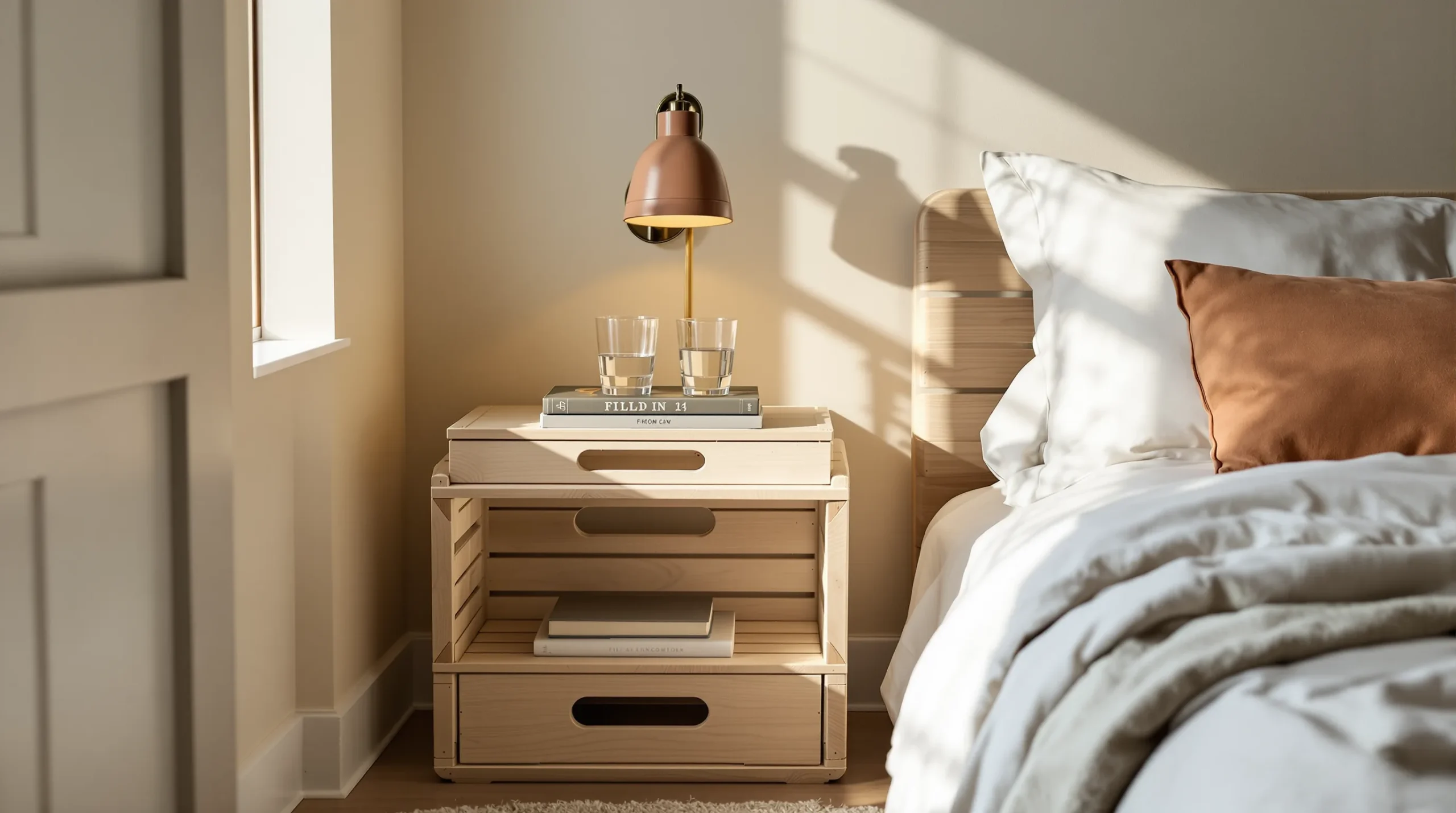
13. Stack a crate nightstand
Cost: ~$20–50 · Time: 30–90 minutes · Difficulty: Easy · Renter-safe: freestanding.
One or two wooden crates, sanded and waxed (or painted), stacked open-side out: surface on top, shelf inside. It's the fastest storage-plus-surface build there is, and in oak tones it photographs far above its price.
14. Repurpose a C-table or ladder shelf
Cost: ~$30–90 · Time: zero build · Difficulty: Easy · Renter-safe: freestanding.
Not every "DIY" needs sawdust: a C-table slides its foot under the bed and floats a surface over the mattress edge; a slim ladder shelf gives a tight corner four levels of nightstand. Keep a leaning ladder's top shelves light, or secure it — tall and leaning follows the anchoring rule.
15. IKEA-hack a RAST or TARVA
Cost: ~$50–120 · Time: 2–4 hours plus drying · Difficulty: Medium · Renter-safe: freestanding.
This one's a classic for a reason: an unfinished IKEA RAST/TARVA chest plus paint, new knobs, and optional legs becomes a bespoke-looking mini dresser-nightstand. Choose a lower-emission (low-VOC) paint — under 50 g/L for flat, under 100 g/L for non-flat finishes counts as low-VOC per Green Seal — and paint with the window open: the EPA notes indoor VOC levels run far higher than outdoors, and "low-VOC" doesn't mean fume-free (EPA).
16. Flip a thrifted piece
Cost: ~$30–100 all-in · Time: 1–2 days including drying · Difficulty: Medium · Renter-safe: freestanding.
The $30 secondhand dresser is the best value in furniture. The flip that lasts: clean hard, sand lightly, two thin coats of low-VOC paint, new hardware. Stay inside your room's palette (idea 22) so the flip looks curated, not crafty — and if it's tall, anchor it like any dresser.
Soft DIY — textiles without a sewing machine (17–19)
Hem tape is DIY's best-kept secret: iron-on, no thread, no machine.
17. No-sew cushion covers
Cost: ~$15–50 · Time: 1–2 hours · Difficulty: Easy · Renter-safe: inherently.
Wrap a cushion in a fabric square and knot it like a gift, or hem-tape three edges into a proper cover. Two or three textures — linen, bouclé, brushed cotton — in one palette upgrades the whole bed for the price of fabric offcuts.
18. Refresh the bedding with hem tape
Cost: ~$15–40 · Time: ~1 hour · Difficulty: Easy · Renter-safe: inherently.
Iron a contrast border onto a plain duvet cover, or hem-tape a length of soft fabric into a bed-end throw. The layering formula that makes it read plush lives in our cozy bedroom guide — this is the make-it-yourself route to the same stack.
19. No-sew curtains on a tension rod
Cost: ~$25–60 · Time: ~1 hour · Difficulty: Easy · Renter-safe: tension only.
Hem-tape store panels (or a soft king sheet) to length and hang them on a tension rod inside the window frame. One check before you buy: the rod's rating. A quality rod carries up to ~15 lb; the cheapest carry three or four — lightweight panels only, or a better rod.
Small organizing builds (20–21)
Two quick builds; the full storage playbook (under-bed, vertical, closet) stays in the small bedroom ideas hub.
20. Lean a pegboard or stick a rail
Cost: ~$25–70 · Time: ~1 hour · Difficulty: Easy–Medium · Renter-safe: lean it, or adhesive within ratings.
Pegboards normally screw to the wall — the owner route. Renters: lean a framed pegboard on the desk or dresser against the wall, or run an adhesive rail with hooks, keeping the total load inside the hook ratings from idea 1. Jewelry, hats, and the charging cable chaos all get a home.
21. Roll a crate under the bed
Cost: ~$20–45 · Time: ~45 minutes · Difficulty: Easy · Renter-safe: freestanding.
Screw four casters into a wooden crate (the one place screws are fine — it's your crate) and you've built a rolling under-bed bin that actually comes back out. Two of them swallow shoes and off-season layers.
Make 23 projects look like one room (22–23)
The difference between "DIY'd" and "designed" is editing.
22. Pick three projects, one palette
Cost: $0 · Time: one decision · Difficulty: the hardest one here.
Don't do all 23. Choose three that solve your room's real problems, execute them in one palette — oat, greige, one clay or sage accent — and stop. A leaning headboard, a canopy, and a crate nightstand in matching tones read as a designed room; seven mismatched crafts read as a fair stall. Restraint is the most valuable build in this list.
23. Plan the un-install from day one
Cost: $0 · Time: 10 minutes · Difficulty: Easy.
Renter-safe means leaving clean. Keep every product's removal method in mind as you install (stretch-release for strips — straight down, slowly), bag the original hardware and knobs from any flip in a labeled zip-bag, and photograph the room before your first project and after your last. Move-out becomes an afternoon, not a negotiation.
DIY mistakes that cost deposits
- Overloading strips — or stacking them — ratings are per product and per set, and they're smaller than people assume; don't count on stacking strips to add capacity, because the wall surface is still the limit.
- Wallpaper on flat or fresh paint — the manufacturers themselves warn it can pull paint; satin/semi-gloss, cured 30–60 days, sample first.
- A canopy on ceiling hooks — they hold half a pound.
- Painting with the windows shut — low-VOC means lower-emission, not fume-free; open the window and keep it open while it dries.
- Starting five projects, finishing none — three finished builds in one palette beat five half-done ones every time.
Frequently asked questions
How can I decorate a small bedroom DIY on a budget?
Start with the three ground rules (weight limits, wall prep, surface testing), then pick the under-$50 wins: a washi-tape headboard outline, a string-light frame, and no-sew cushion covers. All three finish in a weekend, stay inside one palette, and come off the wall clean.
How much weight do Command strips actually hold?
By the manufacturer's listed ratings: picture-hanging strips hold 1 lb (small), 3 lb (medium), or 4 lb (large) per set, and a frame hung on four sets spreads roughly four times that. Hooks run from 5 lb (Large) to 7.5 lb (Jumbo), wall curtain-rod hooks about 10 lb — and ceiling hooks only half a pound. Ratings are per product and per set, so recheck the pack you buy.
Does peel-and-stick wallpaper damage walls?
Not when the conditions are right: a smooth wall in satin or semi-gloss paint that's fully cured (30–60 days after painting). On flat, matte, or freshly painted walls, removal can pull paint — the manufacturers say so themselves and recommend testing a sample corner first.
What's the best DIY headboard for renters?
An upholstered leaning headboard: a plywood panel with foam, batting, and fabric stapled on, leaned behind the mattress so the bed pins it — no holes at all. Expect roughly $40–100 in materials, two to three hours, and a medium skill level (mostly stapling).
How do I DIY a bedroom without drilling?
Lean it, tension it, or stick it within ratings: leaning headboards and mirrors, tension-rod curtains and canopies, and adhesive strips or hooks matched to the weight of what they hold. Everything in this guide has a no-drill route except the honest exceptions (picture ledges and wall-mounted pegboards, which need screws).
How do I keep a DIY bedroom from looking cluttered?
Pick three projects, run one palette across them, and plan the un-install. DIY reads designed when the palette is consistent and the wall stays calm — the same warmth-with-restraint rule that runs through the rest of this site.
Built by you, safe for the deposit
The best bedroom ideas for small rooms DIY come down to numbers first, prep second, restraint third. Check the rating before you stick, wipe and wait like the manufacturer says, choose builds that lean or tension instead of drill — and stop at three projects in one palette. That's a room that looks custom, cost a weekend, and leaves no trace in the walls. For the storage, layout, and make-it-bigger groundwork under all of it, head to our full small bedroom ideas guide.
Pick your three and start with the ground rules. Then grab the free small-space checklist for the printable project spec cards, and save the ideas from our Small Bedroom Inspiration board. Making the rest of the room feel as good as it looks? See cozy bedroom ideas.
Written by Nourddine, founder of Calm Square Feet, where he shares warm-minimalist, renter-friendly ideas for small apartments and studios. [More about me → /about].
Sources
- 3M Command, Product Weight Limits, retrieved 2026-07-11, https://www.command.com/3M/en_US/command/how-to-use/product-weight-limits/
- 3M, Command Strips FAQs (application/removal protocol PDF), retrieved 2026-07-11, https://service.mattel.com/instruction_sheets/3M%20Command%20Strips%20FAQs[1].pdf
- Umbra, Anywhere Curtain Rod (15 lb rating), retrieved 2026-07-11, https://www.umbra.com/products/anywhere-curtain-rod
- Lowe's, Project Source tension rod listing (3–4 lb rating), retrieved 2026-07-11, https://www.lowes.com/pd/Project-Source-28-in-To-48-in-White-Steel-Tension-Curtain-Rod/1000514099
- Tempaper, How to Install Peel and Stick Wallpaper, retrieved 2026-07-11, https://tempaper.com/pages/how-to-install-wallpaper
- WallPops, Frequently Asked Questions (removability, paint cure), retrieved 2026-07-11, https://www.wallpops.com/frequently-asked-questions
- Green Seal, Guide to VOCs in Paint, retrieved 2026-07-11, https://greenseal.org/guide-to-vocs-in-paint-and-cleaning-products/
- US EPA, Volatile Organic Compounds' Impact on Indoor Air Quality, retrieved 2026-07-11, https://www.epa.gov/indoor-air-quality-iaq/volatile-organic-compounds-impact-indoor-air-quality
- Talker Research, Study reveals shift toward long-term renting in U.S. (survey of 2,000 US renters for Lemonade, May 2025), retrieved 2026-07-11, https://talkerresearch.com/study-reveals-shift-toward-long-term-renting-in-u-s/
- IKEA, MOSSLANDA picture ledge (16.53 lb, screw-mounted), retrieved 2026-07-11, https://www.ikea.com/us/en/p/mosslanda-picture-ledge-white-90292103/