Small Bedroom Storage Ideas: 23 Ways to Find Hidden Space
Your small bedroom is hiding more storage than you think — probably 15 cubic feet or more that you're walking past every day. A standard full or queen bed alone sits over roughly 16 to 20 cubic feet of dead air. The problem is almost never that a small bedroom has no space; it's that the space is unfound. In a 2025 survey, 35% of people living in homes under 1,000 square feet were paying for a self-storage unit — versus 25% of people in homes over 3,500 — and the top reason was simply "lack of space at home" (StorageCafe). A lot of that overflow never needed to leave the room.
So these small bedroom storage ideas work differently from the usual photo gallery. Instead of a pile of disconnected tips, we'll do a zone-by-zone audit — under the bed, up the walls, over the door, above the closet rod, into the dead corners — with real capacities, every fix kept renter-safe and no-drill, and one rule running underneath it all: storage should make a small room feel calmer, not busier.
Small bedroom storage ideas in 60 seconds
Audit the five zones and you'll find the space. Capture under the bed first (it's the biggest single volume), then go vertical, over the door, and into the closet using no-drill methods so you keep your deposit, and fight visual weight as you go — match your bins, keep busy storage off the walls you see first, and curate the wardrobe before you build around it. Everything below is that framework in detail.
Key takeaways
- Audit before you buy. A small bedroom hides 15+ cubic feet across five zones — a full/queen bed alone sits over ~16–20. Find it before you add furniture.
- Under the bed is your biggest win: measure floor-to-frame, subtract an inch, and fill it with 6-inch bins (about 3–4 under a full/queen) or a drawer bed.
- Go up and stay no-drill: Command strips to weight (1/3/4 lb per pair), tension rods, over-door organizers, and a second closet rail add storage without a single hole.
- Fight visual weight: match bins to one neutral palette, keep closed storage on the walls you see first, and curate the wardrobe before you store it.
Start with a hidden cubic-feet audit
Before you buy a single bin, walk the room like an inspector. This is the step every competitor skips, and it's the one that actually works.
1. Walk the five zones and measure
Stand in the doorway and look for the space you've stopped seeing: the gap under the bed, the empty vertical wall above furniture, the back and swing-space of the door, the dead air above the closet rod, and the corners. Jot the rough dimensions of each. You're not decorating yet — you're taking inventory of volume. Most people are genuinely surprised to find they have more unused cubic footage than their entire dresser holds.
[Infographic — hidden cubic-feet audit: a simple bedroom cutaway labeling the five zones with their typical hidden volume — under-bed ~16–20 cu ft, vertical wall, over-door, above closet rod, corners]
2. Curate before you capture
Storage math only works if you're not building shelves for things you'll never touch. Clothing is the single biggest non-furniture category people put into storage — about 18% of everything stored (StorageCafe), and in a small bedroom it's usually the main offender. Edit the wardrobe down to what you actually wear first; you'll often find you don't need half the storage you were about to buy. (For the make-it-feel-bigger fundamentals underneath all of this — mirrors, sightlines, light — start with our small bedroom ideas hub.)
Here's the whole audit at a glance — the five zones, roughly how much each hides, and the no-drill way to capture it (the volumes are estimates from typical dimensions, not a rule):
| Zone | Hidden volume (typical) | Best no-drill capture |
|---|---|---|
| Under the bed | Full/queen ≈ 16–20 cu ft (capture ~8–12) | 6-inch bins, or a drawer bed |
| Vertical wall | wall height × ~10-inch shelf depth | floating shelves + baskets, hung to Command weight |
| Over the door | the full door back | over-door organizer (check the door's thickness) |
| Closet | often 50%+ dead air above the rod | a second hang rail + loop-over shelves |
| Corners | the room's most-ignored triangle | a corner shelf or a tall, narrow tower |
Under the bed: your biggest hidden volume
An average bedroom is only about 100 to 132 square feet (HomeGuide), so the footprint your bed already claims is the smartest place to reclaim.
3. Measure the clearance, then subtract an inch
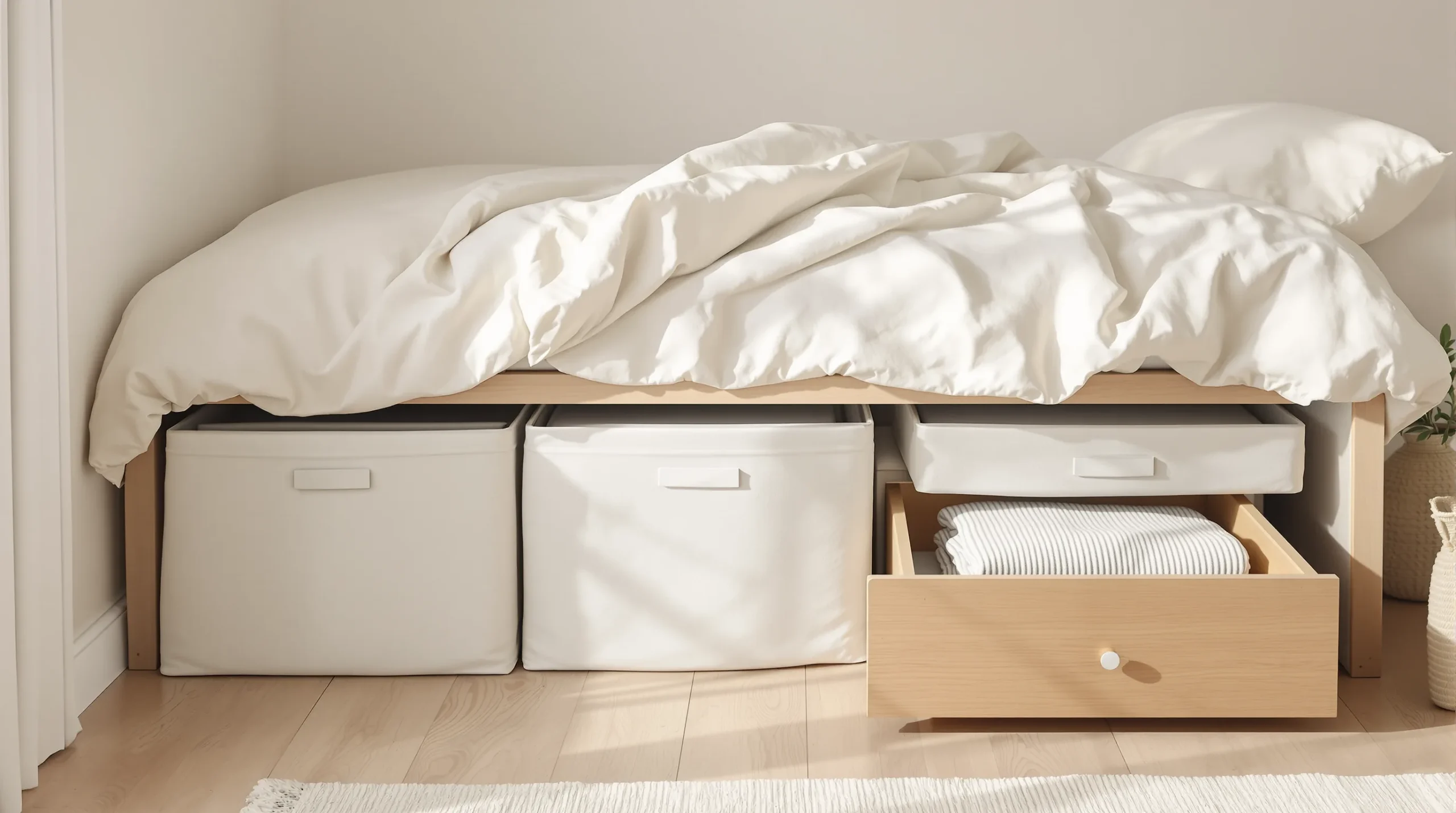
Platform frames usually give you about 4 to 7 inches of clearance; metal frames with exposed legs, 7 to 11. Measure floor-to-frame, then subtract an inch so bins actually slide without scraping. I learned this the annoying way — I once bought four 8-inch totes for a 7.5-inch gap and spent an evening returning all of them. Measure first.
[Infographic — under-bed clearance decision strip: platform 4–7 in → 6-in hard bin · metal frame 7–11 in → tall bin or fabric case · add risers +3–8 in for more]
4. Fill it with 6-inch bins
The workhorse is a shallow, clear, snap-lid box — a 41-quart underbed bin runs about 29⅜ × 18 × 6 inches and clears most platform frames (Sterilite). Three or four of them fit under a full or queen and capture roughly 8 to 12 cubic feet — the bulk of that hidden volume, for about $10 to $20 a bin. (Treat every price here as a ballpark to check when you shop.)
5. Soften the look with fabric cases and a skirt
Clear plastic reads as "storage," which adds visual noise. Swap in a ventilated fabric case like IKEA's SKUBB (35½ × 20¾ × 7½ inches, about $13) — note the taller 7½-inch height needs a metal frame or risers — and finish with a simple bed skirt so the whole zone disappears from sightlines. Hidden storage is calm storage.
6. Add risers if you need more
Bed risers add another 3 to 8 inches of usable height, which can nearly double under-bed capacity. Just don't raise the bed so high it wobbles, and keep the risers to a finish that vanishes.
7. Or let the bed frame do the work
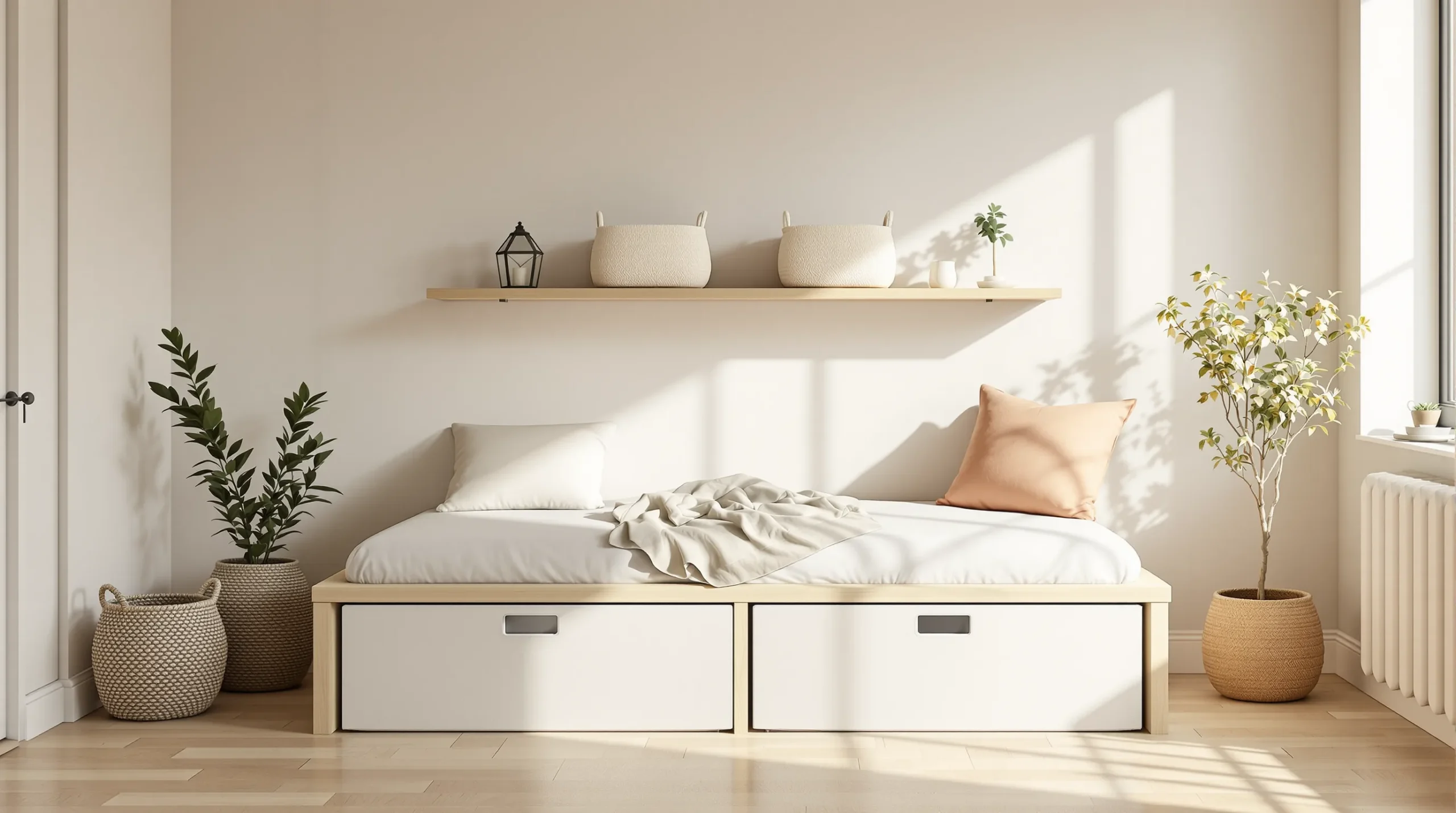
If you're buying a bed anyway, a drawer or storage frame turns the whole footprint into built-in dressers. Which frames are actually worth it — and how their open dimensions compare — is a teardown we keep in our space-saving furniture guide, so choose it there rather than guessing.
Go vertical: buy back the floor
The fastest way to make a small bedroom feel bigger while adding storage is to move things off the floor and up the wall, where a small room has its most unused surface.
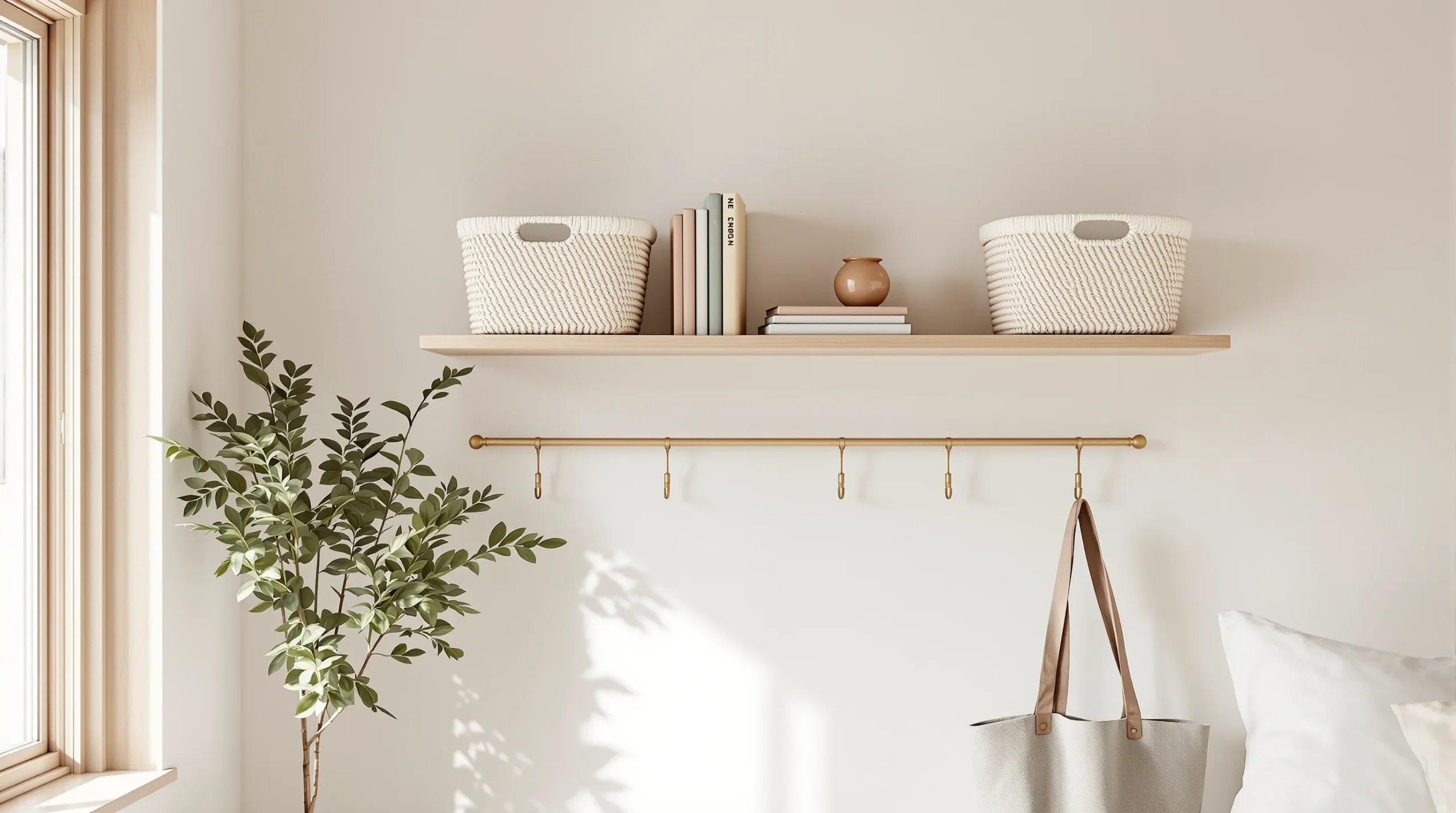
8. Put floating shelves up high
A row of slim wall shelves (IKEA's LACK or BERGSHULT, roughly $8 to $29) turns bare wall into storage and display. Keep them to one finish so the wall reads calm, not busy. Renters: hang light shelves with Command strips rated to the load — the picture-hanging strips hold about 1, 3, and 4 pounds per pair in small, medium, and large. Check our DIY bedroom guide for the full no-drill weight breakdown before you load anything heavy.
9. Use a picture ledge as a surface
A narrow picture ledge makes a floating bedside or vanity shelf that barely projects into the room. The screw-mounted versions hold real weight; if you can't drill, lean a short ledge on top of a dresser instead for the same effect without the holes.
10. Go tall and narrow, not short and wide
A slim, tall bookcase stores the same volume as a squat one on a much smaller floor footprint — and drawing the eye upward makes the ceiling feel higher. Anything tall needs to be anchored to the wall so it can't tip; that anchoring rule (and why it matters most in shared and kids' rooms) lives in our small kids' bedroom guide.
11. Hang the "re-worn" tier
The jeans and hoodie you've worn twice but aren't ready to wash don't belong on the chair. A few Command hooks or a slim wall rail — the large utility hooks hold about 5 pounds each — give that in-between layer a home off every surface.
12. Add a pegboard for the small stuff
A pegboard turns a square of wall into flexible storage for jewelry, sunglasses, and accessories. Drilling one in is an owner move; renters can use an adhesive-mounted rail within its rated weight, or simply lean a framed pegboard against the wall on a dresser.
Over the door and behind it
The door is a full rectangle of vertical real estate most people never touch.
13. Hang an over-door organizer
A pocket or shelf organizer that hooks over the door top needs zero drilling — but check two things: your door-top thickness (many only fit doors up to about 1.375 to 1.75 inches), and the specific model's stated weight per hook or shelf, since capacities vary widely. Match the organizer to the door, not the other way around.
14. Add over-door hooks
A simple over-door hook rack holds robes, bags, or tomorrow's outfit, clearing the back of the door of the pile that usually lands on a chair.
15. Claim the sliver behind the open door
The wall the door swings toward is often completely empty. A shallow rack or a vertical run of hooks there stores flat things — belts, scarves, a folding step stool — in space that was doing nothing.
The closet, or the missing one
Whether you have a tiny closet or none at all, this is where the biggest capacity gains hide.
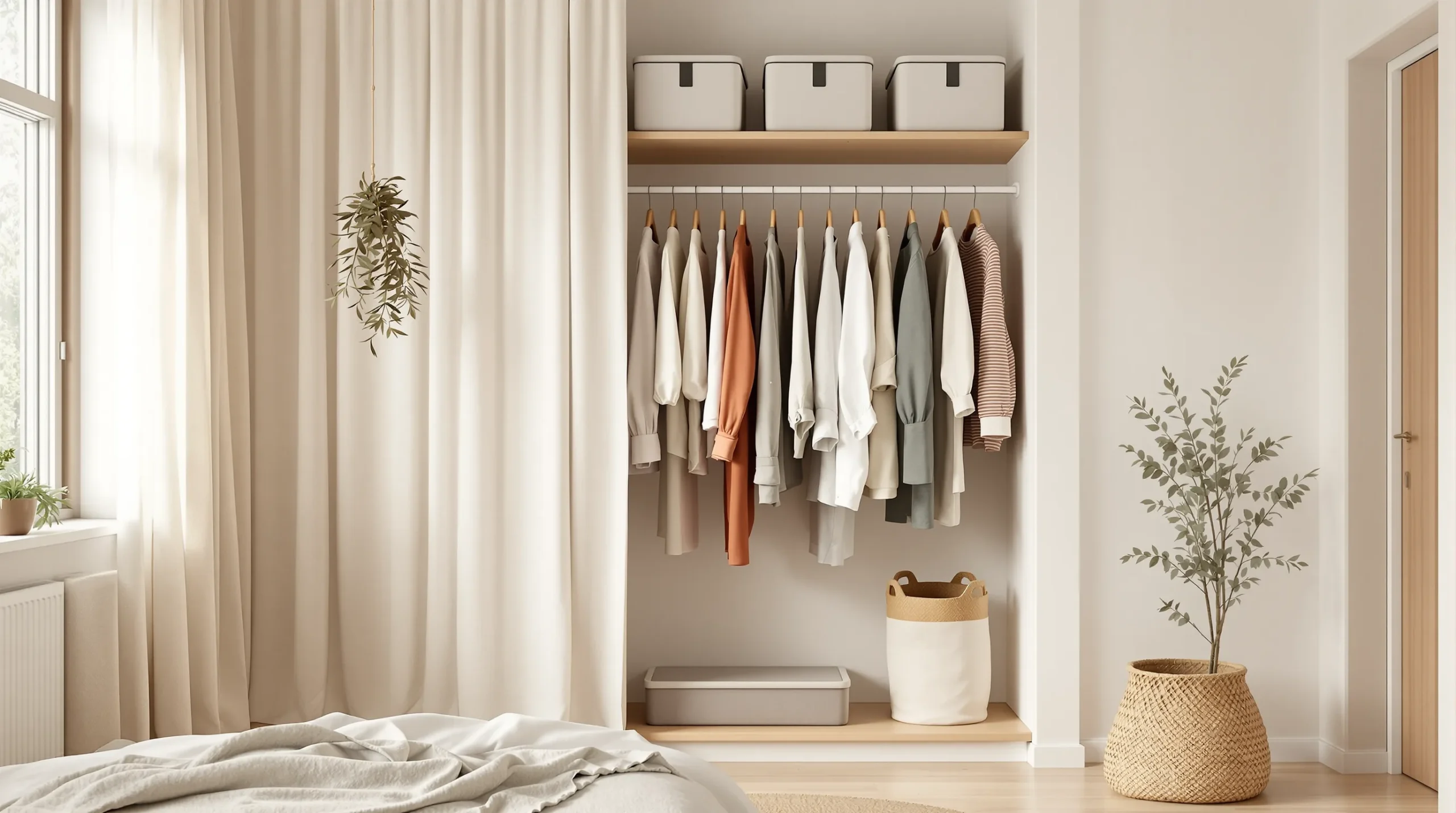
16. Add a second hanging rail
Most single-rod closets waste the bottom half of their height. A hang-down second rail like IKEA's MULIG (adjustable 23⅝ to 35⅜ inches, about $7) instantly doubles your hanging space for shirts and folded trousers.
17. Slot in no-drill closet shelves
Fabric hanging shelves that loop over the existing rod (IKEA's STUK and similar) add cubbies for folded knits without a single screw — ideal for renters and instantly reversible.
18. Claim the shelf above the rod
The high shelf above the closet rod is prime off-season storage. Fill it with matched lidded bins — same palette, same size — so it reads as tidy architecture rather than a jumble.
19. No closet? Build a soft one
If there's no closet at all, make one that comes apart when you leave: a free-standing wardrobe or armoire, an open garment rack, or a tension rod hung across an alcove with a curtain drawn in front. Pair any of these with a real wardrobe edit — a smaller, curated set of clothes is the only "storage upgrade" that also makes getting dressed easier.
Headboard, nightstand, and corners
20. Let the headboard and nightstand store things
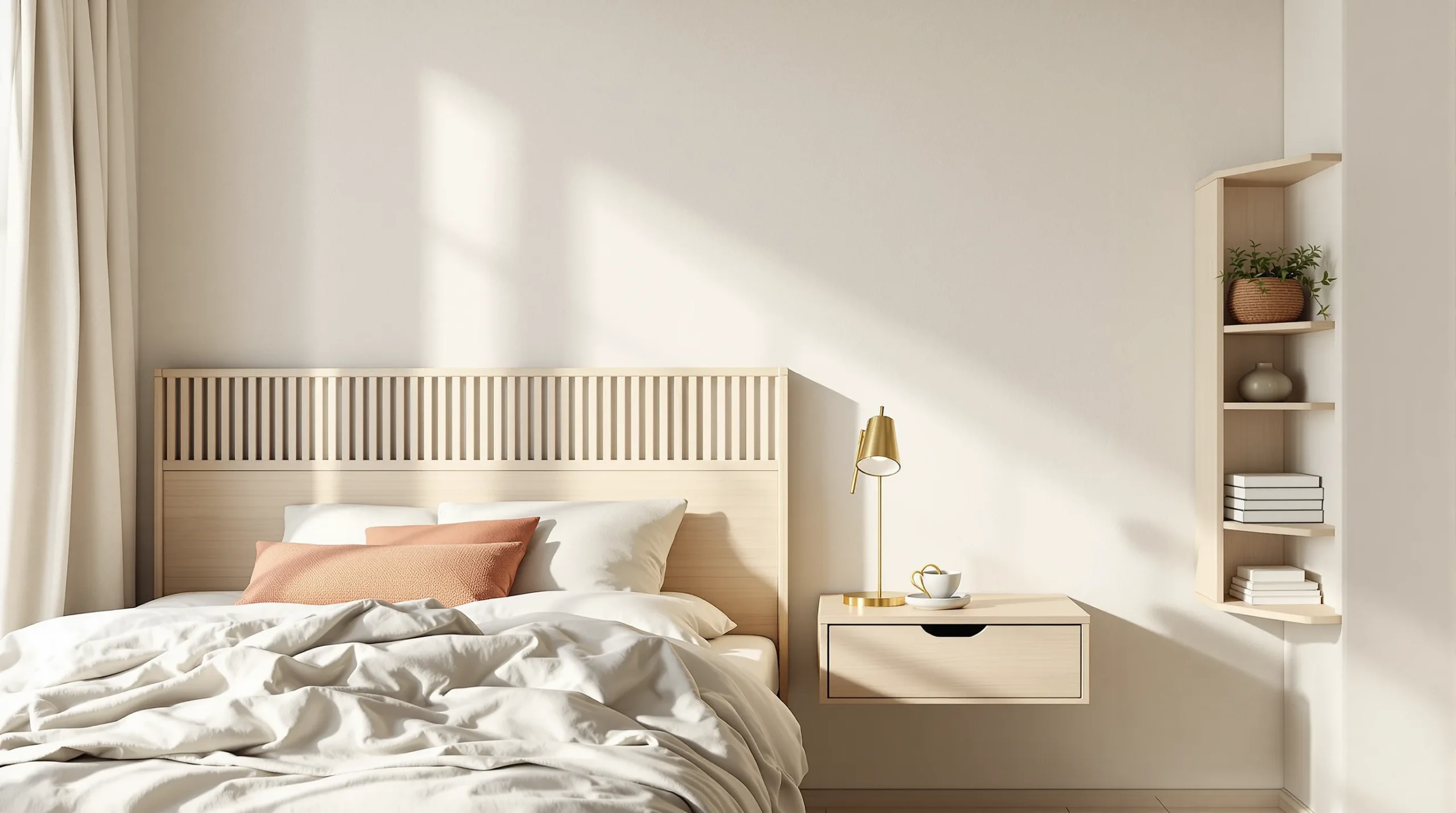
The wall behind your pillows is already occupied — make it work. A bookcase or cubby headboard adds shelving on space the bed uses anyway, and a floating or wall-mounted nightstand keeps the floor open while a drawer hides the charger-and-cable clutter that reads as visual noise. For which storage headboards are worth it, our space-saving furniture teardowns cover the mechanics.
21. Work the dead corners
Corners are the most-ignored square footage in any bedroom. A fitted corner shelf or a slim corner tower turns that awkward triangle into real storage for folded clothes, shoes, or books without eating into your walking space.
The rule that keeps storage from adding clutter
Here's the part the galleries miss entirely: in a small room, visual clutter is as suffocating as physical clutter. 42% of Americans say they feel cluttered frequently or constantly (StorageCafe) — and you can add plenty of "storage" that makes that feeling worse.
22. One palette, closed on the walls you see first
Match your bins and baskets to a single neutral palette, and keep open, busy storage off the wall you face when you walk in. The first time I put up open shelves in a small bedroom, the room somehow felt more cramped — until I swapped the mismatched containers for one set of matching cream baskets, and the same amount of stuff suddenly read as calm. Uniformity is what your eye reads as order.
23. Curate to the space, not the space to the clutter
The goal isn't to cram maximum storage into the room — it's to store what you have and still be able to breathe. Storage should leave the room feeling more restful than before. For the warmth-and-texture side of that calm (layering without adding "stuff"), see our cozy bedroom guide.
Mistakes that waste small-bedroom storage
A few avoidable moves undo all the work:
- Buying bins before measuring the clearance. That inch matters, and returns are a chore.
- Putting open, busy shelving on the first wall you see from the door.
- Drilling a rental for a closet rail when a tension rod, MULIG, or STUK does it with no holes.
- A tall storage tower left against the wall without anchoring it. That's a tip-over risk, full stop.
- Building storage for clothes you haven't worn in a year — edit first, store second.
- Matching nothing — ten containers in ten colors is its own kind of clutter.
- Grabbing an over-door organizer without checking whether it fits your door.
Frequently asked questions
How do I add storage to a small bedroom with no closet?
Build a removable one: a free-standing wardrobe or armoire, an open garment rack, or a tension rod across an alcove with a curtain in front. Add wall hooks and floating shelves for the overflow, use under-bed bins for off-season clothes, and curate your wardrobe down so there's less to store in the first place.
Where do you put clothes in a tiny bedroom without a dresser?
Split them by type: hang the re-worn and hangable items on a rail, fold knits into closed baskets on open shelving (baskets act like pull-out drawers), and send off-season clothes to 6-inch bins under the bed. A second closet rail and in-closet fabric shelves add folding space without furniture.
How do you store things in a small bedroom without it looking cluttered?
Match your storage to one neutral palette, favor closed bins and baskets over open piles on the walls you see first, hide the under-bed zone with a skirt, and keep one personal object per surface. Curate before you store — less stuff in matching containers reads as calm.
What renter-friendly bedroom storage works without drilling?
Command hooks and strips used within their weight ratings (roughly 1–4 pounds for picture strips, 5 for large hooks), tension rods, over-door organizers, free-standing racks and shelves, under-bed bins, and loop-over in-closet fabric shelves. Our DIY bedroom guide has the full no-drill weight chart.
How much storage actually fits under the bed?
More than you'd guess. A full or queen sits over roughly 16 to 20 cubic feet; with 6-inch bins you can realistically capture 8 to 12 of that — about three or four 41-quart boxes. Measure your clearance, subtract an inch for a smooth slide, and add risers if you want more height.
What's the best way to store clothes in a small bedroom?
Since clothing is the number-one thing that overflows a small bedroom, build that system first: hang what re-wears and wrinkles, fold knits onto shelves or into bins, store off-season under the bed, and edit ruthlessly. A doubled closet rail plus one under-bed system handles most wardrobes.
Bringing it all together
The best small bedroom storage ideas don't start at the store — they start with a tape measure and an honest look at the five zones you've stopped seeing. Audit the hidden cubic feet, capture the under-bed volume first, go vertical and over-door and into the closet with no-drill methods that protect your deposit, and keep the whole thing calm by fighting visual weight. Do that, and a genuinely small bedroom holds everything it needs to — without the storage unit, and without feeling one bit more crowded.
Ready to build out the rest of the room? Start with the small bedroom ideas hub, see which pieces earn their footprint in our space-saving furniture guide, and if you're in one room, our studio apartment layout guide zones the bedroom in. More about Calm Square Feet on our about page. Want the printable zone-audit and clearance cheat sheets? grab the free small-space storage kit, and save these from our Small Bedroom Inspiration board.
Sources
- StorageCafe — Self-Storage Demand & Trends 2025 (clutter, small-home storage use, clothing share): https://www.storagecafe.com/blog/self-storage-demand-and-trends-2025/
- HomeGuide — Average Bedroom Size: https://homeguide.com/articles/average-bedroom-size
- Sterilite — 41-Quart Underbed Storage Box dimensions: https://www.sterilite.com/product-page.html?product=19608006
- IKEA — SKUBB storage case: https://www.ikea.com/us/en/p/skubb-storage-case-white-80591051/
- IKEA — bedroom storage gallery (MULIG clothes bar, STUK, BOAXEL): https://www.ikea.com/us/en/rooms/bedroom/gallery/a-bedroom-where-everything-is-in-its-place-pub812b7ef8/
- 3M Command no-drill weight ratings (per-set 1/3/4 lb strips; 5 lb large hook) — full breakdown in our DIY guide: /bedroom-ideas-for-small-rooms-diy/