Small Kids Bedroom Ideas: 23 Safe, Space-Smart Ways
A small kids' room has to do three hard things at once: be safe, grow with your child, and fit sleep, play, study, and a mountain of toys into a tiny footprint. Most "kids room" lists skip straight to bunk beds and bright colors and leave out the part that matters most — safety. So we'll start there, with the one idea that genuinely saves lives: a child is treated in an emergency room for a furniture or TV tip-over every 53 minutes, so anchor everything. Here are 23 small kids bedroom ideas — safe, renter-friendly, and built to grow with your child — for one kid or two sharing. This is the kids' companion to our small bedroom ideas guide, which covers the general storage, layout, and make-it-bigger basics.
Key Takeaways
- A small kids' room has three jobs: be safe, grow with your child, and fit sleep + play + study + toys in a tiny footprint.
- Anchor everything. A child is ER-treated for a furniture or TV tip-over every 53 minutes, and children are 71% of tip-over deaths (CPSC) — strap every dresser, bookcase, and TV, even in a rental.
- Buy once: a convertible crib (crib → toddler → daybed → full) and an adjustable-height desk grow with your child instead of being replaced every couple of years.
- Two kids, one small room: a bunk or trundle reclaims the floor — but no child under 6 on the top bunk, and guardrail gaps stay ≤3.5 inches (AAP) — plus a shared-but-personal shelf, light, and color for each child.
What makes these small kids bedroom ideas work?
Four jobs, in this order. First, make it safe: anchor the furniture, cut the cords, keep pieces low and stable. Second, buy furniture that grows with the child, so a tiny room doesn't force you to re-buy every year. Third, zone the room for sleep, play, and study, even if all three are within a few feet of each other. Fourth, give toys storage a child can actually reach and use. Get those four right and a small room works for years. Everything else — the colors, the decals, the cute stuff — comes after.
Safety first — anchor everything (1–4)
In a kids' room, safety isn't a section you can skip to feel good about. It's the foundation the whole room stands on, and in a small room where furniture is close to the bed and the play space, it matters even more.
1. Anchor every dresser, bookcase, and TV
Here's the number that should change how you set up the room: a child is treated in an emergency room for a furniture or TV tip-over every 53 minutes, and children make up 71% of all tip-over deaths — 137 reported child deaths from January 2013 through July 2023, and nearly half of those fatalities (47%) involved a television (CPSC). Anti-tip straps cost a few dollars and take ten minutes: strap every dresser, bookcase, and shelf to a wall stud, and secure or mount the TV. Small children climb furniture like a ladder, and a loaded dresser can go over in an instant. In our own rental we anchored every tall piece with a couple of screws into a stud and spackled the tiny holes at move-out — a ten-minute job I'd never skip again. This is the single most important thing on this entire list.
2. Choose low, stable, STURDY-compliant furniture
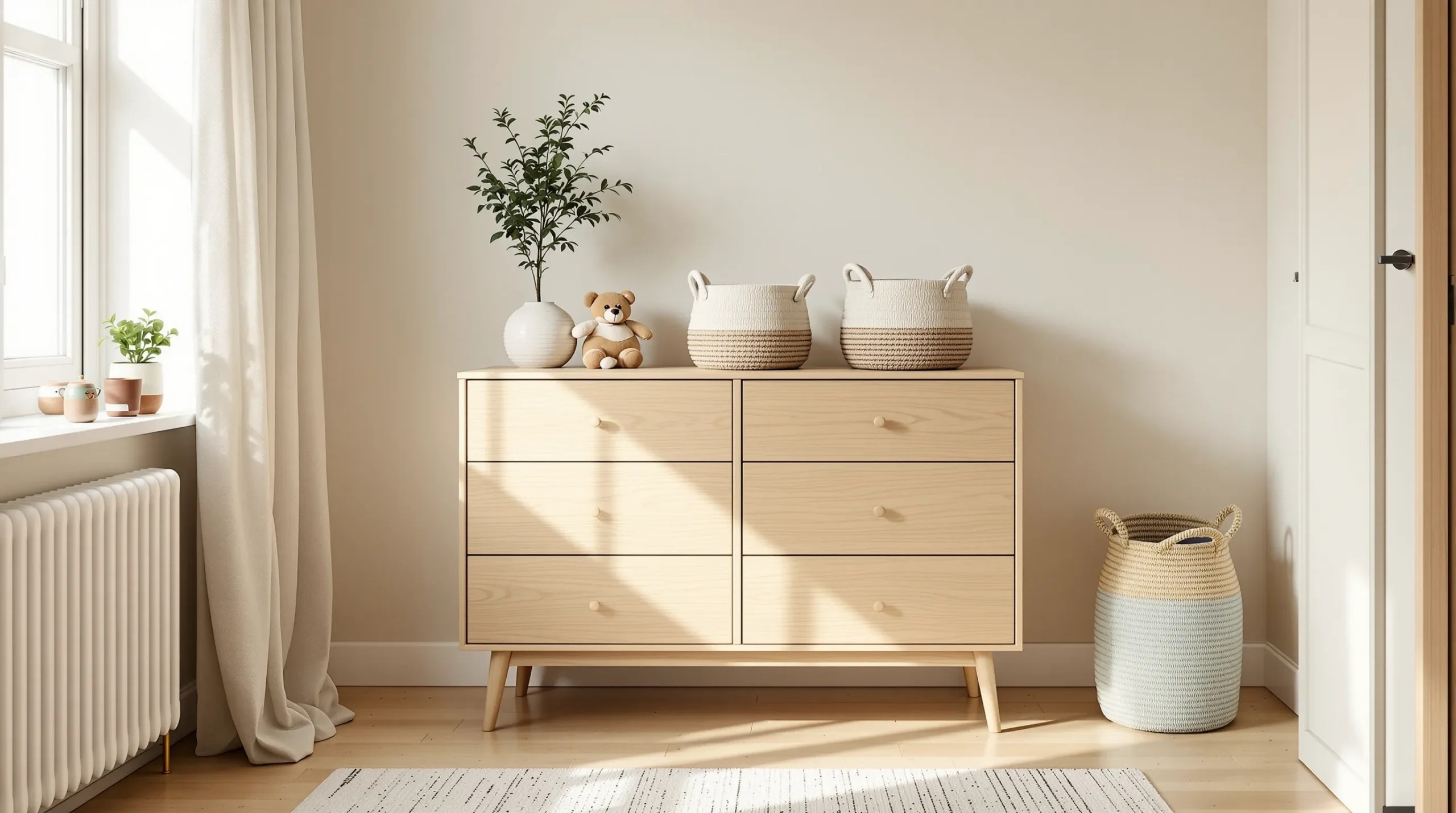
Anchoring is step one; buying stable furniture is step two. Dressers made after September 2023 must now pass the federal STURDY Act stability test — checked with drawers open and loaded, on carpet, under the weight of a child (CPSC / Federal Register). For a small kids' room, favor pieces that are low, wide, and heavy-bottomed; they store just as much, tuck under sightlines, and are far harder to tip in the first place.
3. Go cordless on the blinds
Window-covering cords are a hidden hazard in a child's room. Corded blinds are linked to roughly nine strangulation deaths of children under five each year, and nearly half of all reported incidents are fatal (CPSC #GoCordless). Choose cordless blinds or shades, and never place a crib, bed, or climbable furniture within reach of a cord. It's a cheap swap that removes a genuinely dangerous one.
4. Pick non-toxic, wipeable finishes
A small room concentrates both fumes and sticky fingerprints. Choose low-VOC paint and sealed, washable surfaces so the air stays clean and the mess wipes off. It's a quiet safety-and-sanity win that costs nothing extra if you choose it up front.
Buy furniture that grows with your kid (5–8)
Kids outgrow furniture fast, and a small room punishes every wrong buy with wasted space. The fix is to buy pieces that change as your child does — buy once, not four times.
5. Start with a convertible crib
A 4-in-1 convertible crib converts from crib to toddler bed to daybed to a full-size bed, and can realistically stay in use for around 10 to 15 years. In a small room, that means one bed instead of three or four over the years — the highest-leverage grow-with-them buy there is. (For newborns, follow safe-sleep basics first: a crib, bassinet, or play yard for the first 12 months.) Once your child is past their first birthday, a Montessori-style floor bed is a low, no-tip alternative that also spares a small room a bulky frame — just fully baby-proof the room first, since a floor bed lets a toddler get up and roam.
6. Get an adjustable-height desk and chair
The desk is where a small kids' room earns its keep for a decade — if it grows. Choose an adjustable-height desk and chair and set them to the 90-90-90 rule: elbows, hips, and knees each at about 90 degrees, feet flat on the floor or a footrest, and the screen's top third at or below eye level. Raise it as they grow, and one desk carries them from crayons to homework.
7. Pick a bed that extends or converts
If you're past the crib stage, choose an extendable kids' bed or a toddler-to-full frame that lengthens as your child does, instead of a cute single-age bed you'll replace at five. In a small room, a bed that grows is a bed you only have to find space for once.
8. Use modular, reconfigurable storage
Cube units, stacking bins, and modular shelves can be rearranged as a child's stuff shifts from toys to books to gear. Buy storage that reconfigures rather than a single fixed unit, and it keeps earning its footprint for years. Our space-saving furniture guide covers the dual-purpose pieces worth the money.
Two kids, one small room (9–13)
Two children in one small bedroom is the hardest version of this problem — and the most searched. The goal is to reclaim floor space and give each child a place that feels like theirs, safely.
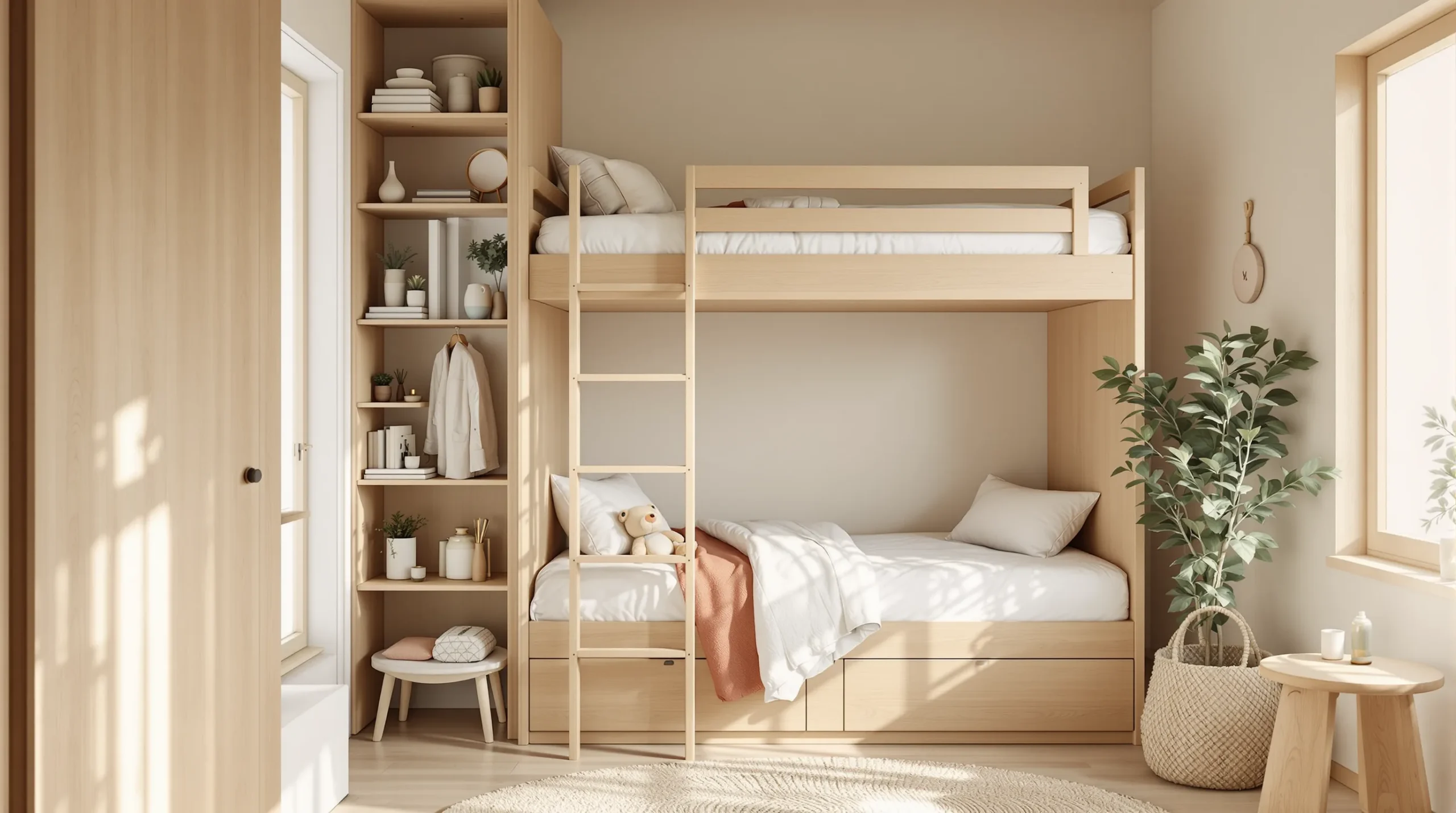
9. Reclaim the floor with a bunk or a trundle
A bunk bed stacks two beds into one bed's footprint; a trundle tucks the second bed away by day to free the floor for play. Either one is the core move for two kids in a small room — it's the difference between a room that's all beds and a room they can actually play in.
10. Follow the top-bunk safety rules
Bunk beds are brilliant for space and a real hazard done wrong — falls are the main way kids get hurt on them. The rules are firm: no child under 6 on the top bunk, guardrails on all open sides with a gap no wider than 3.5 inches and rails at least 5 inches above the mattress, a securely attached ladder, and a night-light so a half-asleep climber can see (AAP). When we set up a bunk for two, the age rule settled every "but I want the top" argument for us — under six sleeps on the bottom, full stop. (One older study of 1990–2005 data found bunk beds sent an average of about 35,790 people 21 and under to ERs a year, roughly half of them under six — a dated figure, but the reason the guardrail rules exist.)
11. Put the bed in a corner
Tuck the bed — or the bunk — into a corner so two walls brace two sides. It adds real stability, gives each sleeper a sense of enclosure, and frees the middle of a small room for everything else. It's the safest and most space-smart placement in one move.
12. Split the room "shared but personal"
Two kids in one room still need a patch that's theirs. Give each child their own shelf, their own reading light, and one accent color, so a shared small room reads as two personal spaces rather than a pile of communal stuff. It heads off a lot of sibling friction before it starts.
13. Divide with a bookshelf, not a wall
To zone two kids without closing in a small room, use a low, open bookcase as a room divider. It marks each child's territory, doubles as storage, and — because it's open — lets light through so the room still feels like one airy space instead of two cramped ones.
Zone a tiny room for sleep, play & study (14–17)
Even a few square feet can hold three zones if each one is defined. The trick is to give sleep, play, and study their own small, clear territory.
14. Define the sleep zone
Anchor the bed area and keep it calm — no screens, minimal clutter, soft light. In a small room where everything is close, a clearly "for sleep" corner helps a child wind down even a couple of feet from where they were just playing.
15. Carve a small floor play zone
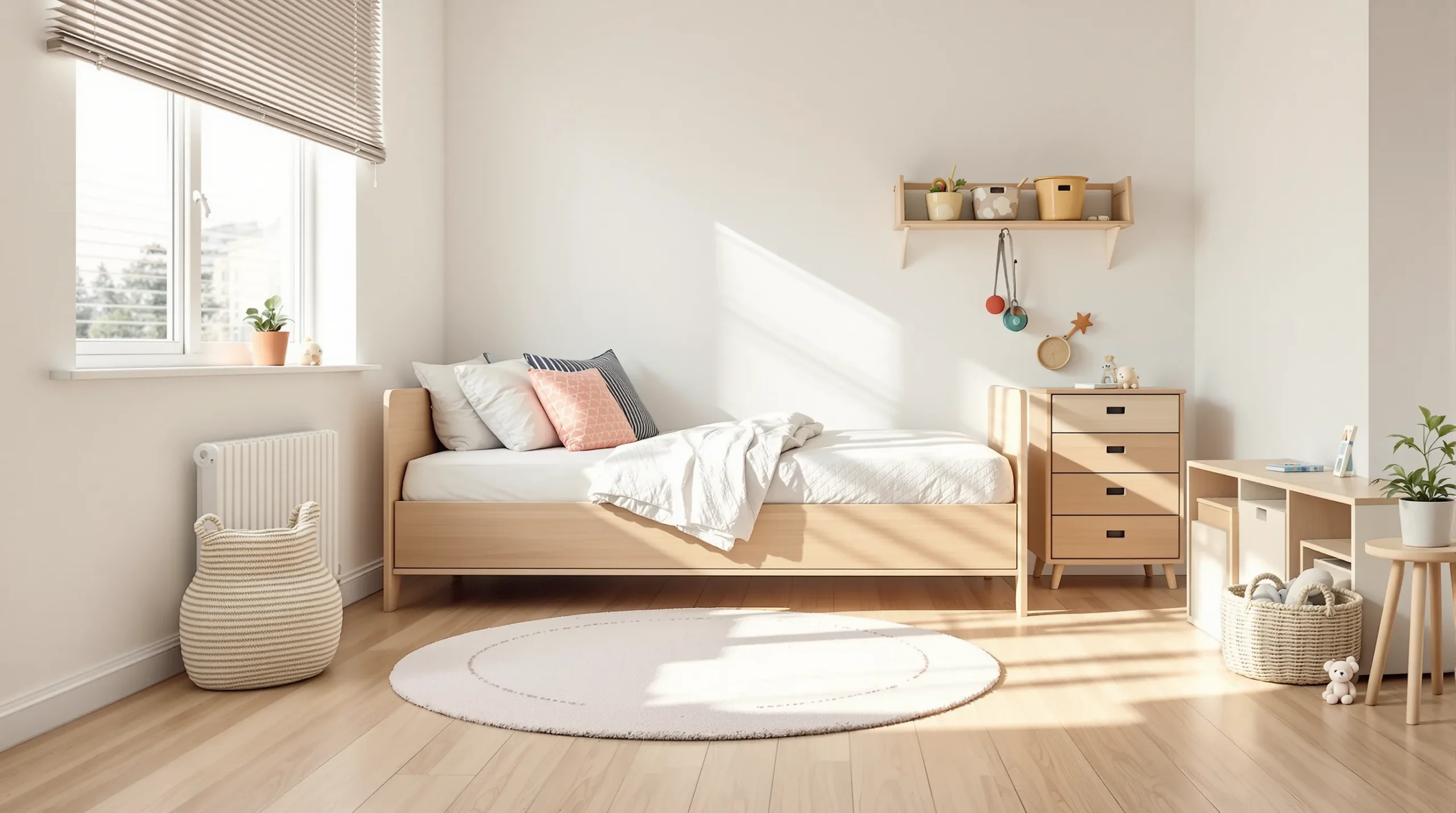
A soft, washable rug is all it takes to say "play here." A loft or bunk bed frees the floor beneath it for exactly this — the single best way to buy play space in a room with none to spare.
16. Add a fold-down or adjustable desk nook
A wall-mounted fold-down desk gives a study spot that folds flat and disappears when it's playtime — ideal for a room that can't spare a permanent desk. Pair it with the adjustable, 90-90-90 setup from idea 6 so it works as they grow.
17. Make a reading corner
A floor cushion, a low shelf of front-facing books, and a cordless light turn a spare corner into a calm reading nook — the quiet counterweight to the play zone. Zoning one small room like this is the same instinct that makes a studio apartment layout work, shrunk to a bedroom.
Toy storage a kid can actually use (18–21)
Toy storage fails when it's built for adults. In a small kids' room, storage only works if the child can reach it, use it, and put things back without help.
18. Keep everyday toys low and open
Store the toys they use daily in bins and cubbies at the child's height, and keep them open rather than lidded. Low and open is what lets a kid get toys out and — the whole point — put them away again, so a small room doesn't drown in stuff by dinnertime.
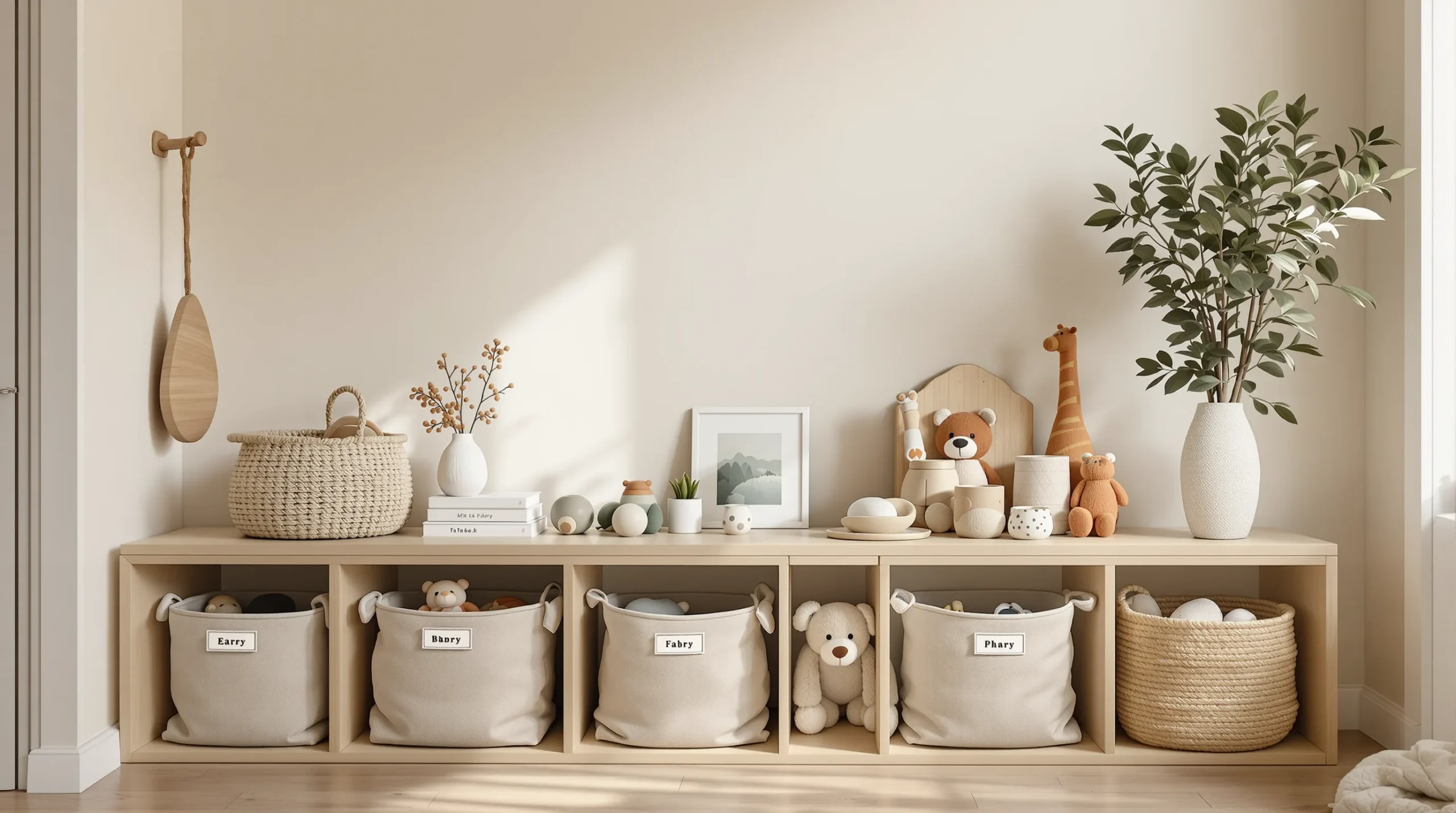
19. Label with pictures, not just words
Picture labels on bins let pre-readers tidy on their own — a small win that keeps a small room manageable and teaches independence at the same time.
20. Use the space under the bed
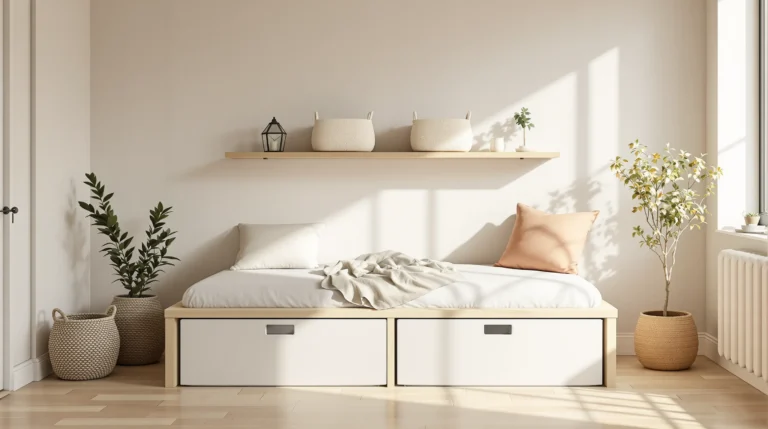
Flat bins under the bed swallow the bulky, less-used toys and out-of-season clothes without taking a single extra square foot. Keep parent-only or rarely-used items up high and out of reach, and let the low, easy zones belong to the child.
21. Rotate the toys
Keep about a third of the toys out and the rest stored, then swap them every couple of weeks. Rotation cuts visible clutter, makes old toys feel new again, and keeps a small room feeling bigger and calmer. (For the general small-room storage playbook, see the small bedroom ideas hub.)
Make a small kids' room feel bigger and calmer (22–23)
Once the room is safe, grows with them, and holds its zones, a couple of restrained choices keep it feeling open — and keep you from redecorating every two years.
22. Light base, one fun accent — not a whole theme
Start with a soft, light base and add just one accent color or a removable wall decal. A fully themed room dates fast, gets outgrown, and — with all that visual noise — makes a small room feel smaller. A calm base with one swappable accent grows with your child and keeps the room feeling bigger. (For the core make-it-bigger moves, see the small bedroom ideas hub.)
23. Keep it calm so it can grow
Restraint is what lets a small kids' room last. Edit the toys and the decor, leave some breathing room, and the same room can carry a child from three to ten without a full redo — calmer for them, cheaper for you, and easier to keep tidy in a tight space. The same warm, calm restraint runs through our cozy bedroom ideas if you want the room to feel snug as well as safe.
Small kids' room mistakes to avoid
Five avoidable mistakes cause most of the trouble in a small kids' room:
- An un-anchored dresser or TV — the number-one hazard on this list; strap everything tall, no exceptions.
- A child under 6 on the top bunk — the age rule is firm; under-six sleeps on the bottom.
- Corded blinds near the bed — swap to cordless and keep the bed away from any cord.
- Buying themed or single-age furniture — you'll replace it fast and lose space in the meantime; buy pieces that grow.
- Toy storage the child can't reach — if it's too high, they can't put things back, and a small room fills up by nightfall.
Frequently asked questions
How do I set up a small kids' bedroom?
Start with safety: anchor every dresser, bookcase, and TV, go cordless on the blinds, and keep furniture low and stable. Then buy pieces that grow with your child (a convertible crib, an adjustable desk), zone the room for sleep, play, and study, and put everyday toys in low, open bins the child can reach. Safe first, then grow-with-them, then zoning and storage.
What age is safe for a top bunk?
Age 6 and up. Pediatric guidance is clear that no child under six should sleep on the top bunk, and the bunk should have guardrails on all open sides with gaps no wider than 3.5 inches, rails at least 5 inches above the mattress, a secured ladder, and a night-light (AAP).
How do 2 kids share a small bedroom?
Reclaim the floor with a bunk or trundle bed, place it in a corner for stability, and split the room "shared but personal" — each child gets their own shelf, light, and accent color. A low, open bookshelf makes a great room divider that also stores things without closing in the space.
How do you anchor furniture in a rental?
Use anti-tip straps screwed into a wall stud or a strong drywall anchor. It's a couple of tiny holes you can spackle and paint at move-out — far less "damage" than a tipped-over dresser, and most landlords consider anchoring reasonable. Some straps also attach with heavy-duty adhesive mounts if you truly can't drill.
What's the best bed for a small kids' room?
For one child, a convertible crib or an extendable bed that grows with them saves the most space and money over time. For two, a bunk (age 6+ on top) or a trundle stacks or tucks the second bed to reclaim floor for play.
How do I make a small kids' room feel bigger?
Keep a light, calm base with one accent instead of a full theme, use low furniture to keep sightlines open, and rotate toys so only a third are out at once. For the full make-it-bigger playbook — mirrors, layout, and rug sizing — see our small bedroom ideas hub.
Safe, calm, and built to grow
A small kids' room doesn't have to be a compromise. Make it safe first — anchor everything, cut the cords, keep it low and stable — then buy furniture that grows with your child, zone the room for sleep, play, and study, and give toys a home a kid can actually use. Do that and a tiny room becomes a safe, calm place your child grows up in, not one you redo every couple of years. For the storage, layout, and make-it-bigger basics underneath all of this, head to our full small bedroom ideas guide.
Pick two or three ideas and start this week — start by anchoring the dresser. Then grab the free small-space checklist for the kids'-room safety-and-setup list, and save the ideas from our Small Bedroom Inspiration board. Setting up the rest of your place? See space-saving furniture and studio apartment layout.
Written by Nourddine, founder of Calm Square Feet, where he shares warm-minimalist, renter-friendly ideas for small apartments and studios. [More about me → /about].
Sources
- U.S. Consumer Product Safety Commission (CPSC), Anchor It! / 2023 Annual Tip-Over Report, posted Feb 2024, retrieved 2026-07-08, https://www.cpsc.gov/Anchor-It
- CPSC / Federal Register, Safety Standard for Clothing Storage Units (STURDY Act, ASTM F2057-23), May 4 2023, retrieved 2026-07-08, https://www.federalregister.gov/documents/2023/05/04/2023-08997/safety-standard-for-clothing-storage-units
- American Academy of Pediatrics / HealthyChildren.org, Bunk Beds: Safety Information for Parents, retrieved 2026-07-08, https://www.healthychildren.org/English/healthy-living/sleep/Pages/Bunk-Beds-Safety-Information-for-Parents.aspx
- CPSC, #GoCordless — Corded Window Covering Hazards, 2023, retrieved 2026-07-08, https://www.cpsc.gov/gocordless
- Center for Injury Research and Policy, Nationwide Children's Hospital, Bunk Bed–Related Injuries (Pediatrics, 2008; 1990–2005 data), retrieved 2026-07-08, https://pubmed.ncbi.nlm.nih.gov/18519473/